
Featured Articles

The New Elders of Zion

Anyone who has looked into the Jewish Question, and even many who have not, likely have at least a passing awareness of the infamous document known as The Protocols of the Elders of Zion—or ‘Protocols’ for short. This small booklet, which first emerged in Russia around 1900, purports to lay out something of a plan for Jewish world domination.[1] Loosely organized into 24 short essays or individual protocols, this rambling, anonymous work portrays itself as a sort of ‘meeting minutes’ or ‘lecture notes’ from an evidently prominent and influential speaker, talking to a group of (presumably) Jews, explaining the means and mechanisms by which they will dominate individual nations and eventually the world via a master leader called “the Sovereign.”

As one might imagine, such a work has been roundly condemned as one of the most anti-Semitic publications of the 20th century. It has also—owing to its anonymity and fuzzy origins—been regularly denounced as a “forgery”; this assertion relies primarily on textual similarities to passages from an 1865 book by a Jewish writer, Maurice Joly, titled Dialogue in Hell. And because it is a forgery, we are told, the work as a whole is bogus and invalid, and therefore ought to be utterly disregarded.

But this, of course, is nonsense. Even if the writer lifted certain passages from Joly’s book as he was writing in (say) the late 1800s, that does not invalidate any truths in it; it simply reveals the author to be a bit of a plagiarist. The protocols could still be legitimate versions or encapsulations of some actual Jewish plan. But since we do not even know if the writer was a Jew (conveying in summary form an actual plan) or a non-Jew (attempting to make the Jews look bad), it is almost impossible to make clear and accurate determinations here.

As for myself, I do claim some knowledge of the origins and context of the Protocols, having edited and translated a new edition of this work in 2023: Protocols of the Elders of Zion: The Definitive English Edition, published by Clemens & Blair. This work includes the full Protocols in a new, readable American English translation, as well as early commentaries from 1920 and 1921, and later analyses by National Socialist and contemporary thinkers. In what follows below, I will be citing this edition.

First appearing in print in Russia in 1903, the Protocols gained some initial traction there during the first Russian Revolution of 1905, a conflict (really, a civil war) in which a force led by the Jew Leon Trotsky and the quarter-Jew Vladimir Lenin violently confronted Czar Nicholas II; the Jews were defeated, but their actions would certainly have at least given credence to a Jewish movement to dominate Russia.

Then came World War One in 1914. The war raged in Europe for three long years, often devolving into a trench-warfare stalemate. England, though, was in increasingly difficult shape, especially into the second half of 1916; in the Battle of the Somme that year, they lost upwards of 600,000 soldiers. Becoming desperate for assistance, the Brits then made a “contract with Jewry” (Temperley) by which they agreed to help the Zionist Jews obtain a homeland in Palestine, if American Jews would bring the U.S. into the war against its will. Pressure on Woodrow Wilson quickly intensified, and he yielded in April of 1917, declaring war on Germany. Britain then reciprocated by drafting the Balfour Declaration, which was signed in November of that year.[2]

Then in March 1917, Russian czar Nicholas was ousted, paving the way for a Jewish-Bolshevik takeover of that nation in October. Jewish activity culminated in late 1918, when Germany collapsed and was defeated, thanks in large part to the revolutionary activity of German Jews like Rosa Luxemburg, Hugo Haase, Karl Liebknecht, Karl Radek, and Kurt Eisner. Thereafter, Jews led the formation of the so-called Weimar government in Germany, dominating that nation for several years—until the rise of Hitler.

Thus, in relatively quick succession, it became obvious to many people that Jewish wartime activity had led to their taking power in Russia and Germany, and demonstrated their dominance over Britain and America. The Jews truly were “taking over the world.” Consequently, the then-15-year-old Protocols, once a curiosity, could now be understood as a very real, very serious plan for world domination. Non-Jews everywhere had to face the Protocols as a literal blueprint for action, and to deal with it accordingly.

“Ruler of the Rulers”

We need to keep in mind two things at this point. One: The state of Israel obviously did not yet exist when the Protocols were written; Israel would not come into being until a UN General Assembly vote in 1947, and was not declared by the Jews until 1948.[3] For the writer(s) of the Protocols, they could only speculate about a future Jewish state in Palestine, which certainly was not imminent in 1900.[4]

Two: World power, however, was another matter. Well before 1900, Jews were already considered by many to be de facto “rulers of the world.” As early as 1798, German philosopher Immanuel Kant remarked that “the wealth of the Jews…apparently exceeds per capita that of any other nation at the present time”.[5] In 1823, the poet Lord Byron wrote “all states, all things, all sovereigns [the Jews] control”.[6] In 1843, Bruno Bauer observed that “the Jew…determines the fate of the whole [Austrian] Empire by his financial power. The Jew…decides the destiny of Europe”.[7] And perhaps more than Europe. In an essay of 1860, Ralph Waldo Emerson remarked on Jewish toughness, brought on by years of persecution and suffering: “The sufferance which is the badge of the Jew, has made him, in these days, the ruler of the rulers of the earth”.[8]

By 1850, German composer Richard Wagner could complain that much of European society was controlled by Jews. It was no longer a question of “emancipation” of the Jews but rather of coming to grips with their power. He wrote: “According to the present constitution of the world, the Jew in truth is already more than emancipated; he rules, and will rule, so long as money remains the power before which all our doings and our dealings lose their force.” Where money rules, Jews rule: this was his message. Hence, “Jewry itself is the evil conscience of our modern civilization.” In a follow-up essay of 1869, Wagner noted that the European press was “entirely directed by Jews”; control of the press, combined with their accumulated wealth, resulted in a Jewry that was “the mightiest organization of our time”.[9]

In 1873, writer Frederick Millingen published a booklet entitled “The Conquest of the World by the Jews.” There, he wrote that “the Jews…are now the wealthiest and most influential class of men; and [they] have attained a position of vast power, the likes of which we do not meet in all history”.[10] Specifically with respect to Germany, in 1879, journalist Wilhelm Marr issued an influential essay, “The Victory of Jewry over Germandom,” decrying the fact that “Jewry has triumphed on a worldwide historical basis.” Into a naïve and innocent Germany “penetrated a smooth, crafty, pliable Jewry” that defeated “the monarchical, knightly, lumbering German by enabling him in his vices”—that is, by exploiting his weaknesses. “Germany is finished,” concludes Marr.[11]

In 1880, Laurent Oliphant could write about the Jews’ “financial operations of the largest scale.” “Owing to the financial, political, and commercial importance to which the Jews have now attained,” they have become an indispensable ally in any future conflict.[12] Then, in his influential book Jewish France (1885), French journalist Edouard Drumont made a shocking and frankly unbelievable claim: “Jews possess half of the capital in the world.” Commenting specifically on France, he noted that the total wealth of that nation was around 150 billion francs, “of which the Jews possess at least 80 billion”—that is, slightly more than half.[13] A decade later, historian Goldwin Smith confirmed this view: “Judaism is now [in 1894] the great financial power of Europe, that is, it is the greatest power of all”.[14]

All this, then, had emerged and was circulating in intellectual circles well before the final version of the Protocols was written. Any talk there about world rule was not mere speculation; it was well underway. It was realistically attainable. And it was within grasp. All they had to do was stick to the plan.

And here it becomes clear, I think, that the identity of the author(s) of the Protocols is perhaps irrelevant. The document describes in fair detail the “Jewish plan” from ages past: Acquire wealth by hook or by crook, use that wealth to corrupt the government, and then use governmental power to tilt the playing-field even more in the favor of Jews. Strive, ultimately, for world control. Do all this while, at the same time, taking every opportunity to debase, degrade, humiliate, and destroy the Goyim (non-Jews); the world is a zero-sum game, and every loss for gentiles is a gain for Jews. Hold no moral code but “Jewry first.” Might makes right, and ends justify the means. This has been the plan for three thousand years, and it is the plan today; it has worked in the past, and it will surely work in the future. “God” (Yahweh) promised this to the Jews long ago, and he has proven true to his word. This is the message of the Protocols. Whether it is the exposé of an actual Jewish cabal or the work of some Jew-hating anti-Semite does not really matter. It lays out the actual plan in stark terms for all to see. We can either act on it, or choose to ignore it.[15]

Two Relevant Questions

In the remainder of this essay, I will focus on two issues: First, how does the plan look today, in light of recent world events? And second, who might plausibly count as the new “Elders of Zion”—that is, who are the most influential Jews (in America, at least), those who might be leading the charge toward Jewish domination?

Let me begin, then, by working through the protocols in sequence, pulling out some select passages that have a particular resonance today. In what follows, the reader must bear in mind that, here in America, both major political parties are dominated by Jewish money. Republicans receive at least 25% of their political funding from Jewish sources, and Democrats at least 50%.[16] Hence, the actions of both parties are reflective of Jewish wants and interests. American politics are Jewish politics, pure and simple.

In the end, the reader must judge for himself whether or not the following quoted passages conform to current events—passages that are now at least 125 years old.

I will describe our system, both from our own viewpoint and from that of the Goyim” (P1, p. 77).[17] The word ‘goyim’ (plural of ‘goy’) is a Jewish term of contempt for non-Jews. This immediately marks it as a (nominal) Jewish document, one in which non-Jews, or gentiles, are viewed with utter disdain. This latter point is hardly contentious; if there is one dominant trait of Jewry from millennia past, it is a kind of misanthropy—a hatred for all non-Jews.[18] Such an attitude is well-documented in the Old Testament, in the Talmud, and in the Shulchan Aruch. This misanthropy has been a virtual hallmark of the Jewish people for thousands of years, and it holds as true today as ever; it is the key component of the Jewish supremacism that drives nearly all rich and powerful Jews.

This task [of crushing those in power] becomes easier if the [Goy] ruler himself has embraced the idea of freedom, of ‘liberalism’” (P1, p. 77). Liberalism, loosely defined as a broad freedom of thought and action, has proven useful to Jews because it gives them license to unleash all sorts of detrimental, damaging ideas and institutions upon otherwise innocent people. In a tightly-run society that operates with oversight, moderation, and regulation, Jews are constrained in their options; in a free and liberal society, “anything goes,” and Jews have a free hand.

Guided entirely by shallow passions, superstitions, customs, traditions, and sentimental theories, the mob becomes embroiled in party dissensions that prevent all possibility of reaching an agreement, even one based on perfectly sound reasoning. Every decision of the mob depends upon an accidental or prearranged majority… (P1, p. 78). In a democracy, the “mob,” the masses, rule; but their decisions are based on all sorts of irrational things (“shallow passions,” “superstitions,” etc.). Party strife—like ‘left’ versus ‘right’—overrides sound thinking and good judgement, even as the Jewish overseers are able to “prearrange” the outcome by manipulating the people via mass media.

“He who desires to rule must resort to cunning and hypocrisy. Noble and popular qualities—like honesty and frankness—become vices in politics, as they will defeat a leader more rapidly than the most powerful enemy” (P1 p. 78). Jewish politics sinks to the lowest common denominator. Moral virtue in a politician is not only irrelevant, it is a handicap.

“Given the present instability of all authority, our power will be more unassailable than any other because it will be invisible until it is so well-rooted that no cunning can undermine it” (P1, p. 79). Jews are masters at hiding both their own identity and the effects of their action. Jewish power is indeed largely invisible to the common man; it takes a fair amount of effort to uncover the truth, even in this Internet age.

The fact that the representatives of the nation can be replaced [via elections], delivers them into our power and practically places their appointment in our hands” (P1, p. 82). American elections are essentially a continuous string of pro-Jewish, pro-Israel candidates. When one leaves office, a new one is “elected” to take his or her place. Exceptions like Kentucky’s Thomas Massie are rare and largely powerless to effect change. Very recently, we have seen a slight shift toward more anti-Israeli (never anti-Jewish) rhetoric, but it remains to be seen how significant this will be.

It is necessary for us that, whenever possible, wars should bring no territorial advantages; this will shift war to an economic basis and force nations to realize the strength of our predominance” (P2, p. 83). Jewish-instigated wars have shifted, since WW2, from territorial gains to economic gains; from territorial defeats to economic defeats. At one time, territory was important, but once Jews gained their Jewish state in 1948, territorial advancement became largely irrelevant—except of course for Israel, which has a never-ending thirst for more land—the Greater Israel project. (The Protocols are rife with explicit double-standards: rules that hold for Goyim but not for Jews.)

The administrators chosen by us from among the people in accordance with their capacity for servility will be inexperienced in the art of government; consequently, they will easily become pawns in our game…” (P2, p. 83). Virtually all prominent politicians, and most minor ones, are utterly subservient to Jewish interests and Jewish money. Their careers live or die upon their conformance with the Jewish-Israeli line. This has been true for at least 50 years in America, but it is more obvious now than ever; just consider how many politicians call for a complete end of aid to Israel; for a prosecution of Israeli war crimes; for an open discussion about the pervasive role of Jews and Jewish money in government, business, academia, press, and entertainment—zero. Utter servility is the name of the game today.

There is one great force in the hands of modern states that arouses thought movements among the people: the press. The press’ role is to indicate necessary demands, to register complaints of the people, and to express and promote dissatisfaction. The triumph of free speech is incarnated in the press; but governments have been unable to profit by this power, and it has fallen into our hands. Through it, we have attained influence, while remaining in the background.” (P2, p. 84). Jews own, control, or otherwise dominate all the major US media corporations: Comcast (Brian Roberts), Disney (Dana Walden, and recently Bob Iger), Warner Bros (Michael DeLuca), Paramount Skydance (David and Larry Ellison), and Fox (Zionist Murdoch family, likely part-Jewish).

“Thanks to the press, we have gathered gold in our hands, although it cost us rivers of blood and tears. It cost us the sacrifice of many of our own people. But every sacrifice on our part is worth a thousand Goyim before God” (P2, p. 84). Of the ten richest Americans, at least five are Jews: Larry Ellison, Mark Zuckerberg, Larry Page, Sergey Brin, and Michael Dell. (Possible Jewish heritage of Elon Musk and Jeff Bezos would of course add to this number.) Not far down the list are other Jews, such as Michael Bloomberg, Jeff Yass, Stephen Schwarzman, Miriam Adelson, Marilyn Simons, Henry Samueli, Len Blavatnik, and Dan Gilbert. Much of their wealth comes from high tech, which is now effectively part of “the press.”

Today I can tell you that our goal is close at hand. Only a small distance remains, and the cycle of the Symbolic Serpent—the symbol of our people—will be complete. When this circle is completed, then all the European states will be enclosed in it, as in unbreakable chains” (P3, p. 85). The EU flag is circle of gold stars on a blue background; it was designed primarily by a Jew, Paul M. G. Levy. Europe is certainly under Jewish control today—both internally and indirectly, via the power of the U.S.

To induce the lovers of authority to abuse their power, we have placed all forces in opposition to each other, having developed their liberal tendencies towards independence. We have encouraged every undertaking in this direction; we have placed formidable weapons in the hands of all parties, and made power the goal of every ambition. We turned governments into arenas in which party wars are fought out. Soon, chaos and bankruptcy will appear everywhere” (P3, p. 85). Political strife is an excellent means by which to distract from the real problem, namely Jewish manipulation and control of society.

We, on the contrary, are concerned with…the degeneration of the Goyim. Our power lies in the chronic malnutrition and weakness of the worker, because through this he falls under our power and is unable to find either strength or energy to combat it. Hunger gives capital a greater power over the worker than any sovereign legal authority under an aristocracy. Through misery, jealousy, and hatred, we manipulate the mob and crush those who stand in our way” (P3, p. 86). Junk food, drugs, alcohol, chemical preservatives, sugar, contrived pandemics—all these serve to addict and sicken the masses, who then can barely function in their daily lives, let alone spend time and effort on serious political matters.

This hatred [of the upper classes] will be still more accentuated by an economic crisis, which will stop financial transactions and all industrial life. Having organized a general economic crisis by all possible underhanded means, and with the help of the gold that is all in our hands, we will throw great crowds of workmen into the street, simultaneously, in all nations” (P3, p 87). An excellent anticipation of the Depression, which was likely induced by Jewish action.[19] This also anticipates later economic crises such as the 1973 oil crisis, the junk bond crisis of the late 1980s, the 2008 housing collapse, and the Covid recession—and now the Iran War financial crisis.

As things stand, as an international force, we are invulnerable; if we are attacked by one state, we are supported by others” (P3, p. 88). In 2003, Malaysian prime minister Mahathir Mohamad said “Today Jews rule the world by proxy. They get others to fight and die for them.” He was speaking of Jewish control over the US military and the executive branch. Of course, Israel is looking very vulnerable at the moment, thanks to Jewish overreach in Iran, Lebanon, and Gaza; but even a defeat there will not mean the end of the power of world Jewry. As long as they own or control trillions of dollars, they are effectively “invulnerable.”

We will create a strong centralized government, so as to collect social forces under our power” (P5, p. 91). Jews have always pushed for centralized governmental control, which makes it much easier for them to manipulate the levers of power. A decentralized system is much harder to control. Consequently, we have seen massive pressure for a large centralized government in the US (since 1900) and in Europe—hence the formation of the EU.

All the wheels of government mechanism move by the action of the motor that is in our hands, and that motor is gold” (P5, p. 92). Money indeed is the decisive factor in U.S. politics, and Jews, by far, donate more political money than any other interest group.

We must direct the education of the Goy societies so that their arms will drop hopelessly at their side whenever they face any task where initiative is required. The intensity of action resulting from individual freedom of action dissipates its force when it encounters another person’s freedom. This strikes a heavy blow against morale, yielding disappointments and failures” (P5, p. 93). Western academia is in a disastrous state, both in the U.S. and Europe. Jewish money, administrators, and faculty have utterly distorted the traditional strength of academia, and a Jewish-inspired “woke” ideology contaminates all levels.

We must be able to overcome all opposition by provoking a war with the neighbors of any country that dares to oppose us. Should, however, those neighbors, in turn, decide to unite against us, we must respond by creating a world war” (P7, p. 97). A remarkable anticipation of both World Wars, not to mention the Cold War, Iraq Wars I and II, Afghanistan War, Ukraine-Russia War, and now, the U.S.-Israeli Iran War. Major wars are marvelously beneficial to Jewish interests; they earn wartime profits, they realign global power structures, and they kill lots of Goyim.

“[T]o sum up our system of enslaving the Goy governments of Europe, we will demonstrate our power to them by assassinations and terrorism” (P7, p. 98). Israel is the leading state-sponsor of terrorism globally, and the Israeli Mossad is the leading organization for political assassination—closely followed by the Jewish-influenced U.S. military and CIA.

As it is not yet safe to give the responsible government posts directly to our brother Jews, we will give them to people whose record and whose character are so terrible that there is a vast gulf between them and the people. Such leaders would face nothing but condemnation and imprisonment, should they disobey our orders. This fact will force them to protect our interests, to their dying day” (P8, p. 99). American Jews directly hold many positions of power (something like 35 current members of Congress, along with cabinet positions and one Supreme Court justice), but the remaining non-Jews are almost uniformly of bad character even as they pander to Jewish-Israeli interests. Jewish blackmail surely keeps many of them in line—likely including President Trump.

We have already effectively destroyed all governments but our own, even though, nominally, many still remain. At present, if any government protests against us, it is done only as a matter of course, and at our desire, and by our order; this is because their anti-Semitism is necessary to enable us to control our lesser brethren” (P9, p. 100). Most Western governments—and many elsewhere—are currently hopelessly dysfunctional or otherwise “destroyed.” Good governance would be a hinderance to Jewish power, and therefore it will be undermined wherever possible. The specter of ‘anti-Semitism’ is routinely raised in all Western nations, both to rally all Jews and to frighten the masses into yet more protective policies toward Jews.

We have affected legal procedure, electoral law, the press, personal freedom—and most important of all, education: the cornerstone of free existence. We have misled, corrupted, deceived, and demoralized the Goy youth by education along principles and theories known by us to be false but which we ourselves have inspired” (P9, p. 101). Self-evident.

A Blatant Double-Standard

The second half of the Protocols moves into a more future-oriented mode of discourse, explaining the coming social order when the Jewish Sovereign is in charge. Notably, many of the things that Jews promote today, under Goy rule, will be eliminated under Jewish rule; this is because they desire harmful and disruptive measures now, but will need relative peace and stability once in power. Double-standards are pervasive. Again, the only rule is “Jewry first.”

When we injected the poison of liberalism into the state organism, its entire political complexion changed; the states became infected with a mortal disease, namely, the decomposition of the blood. It is only necessary to await the end of their agony” (P10, p. 105). Jews have been leading forces in the push for unrestrained immigration, ‘open borders,’ and lax enforcement of visa rules. This was true in the US under several past presidents (Trump is something of an exception, although his actual success at routing out millions of illegals remains to be seen), and it is true of Europe, which has been flooded by at least 20 million Africans and Middle-Easterners since 2000. Racial mixing (“decomposition”) is good for the Goyim because it weakens their genetic integrity and identity; but it is bad for the Jews, who prohibit it by Jewish law.

To accomplish our plan, we will engineer the election of presidents whose past record contains some hidden scandal—then they will be faithful executors of our orders, for fear of exposure, and from a natural desire to retain the privileges, advantages, and dignity connected with the position of president” (P10, p. 106). Compare to the Protocol 8 passage cited above.

We must exhaust everyone by dissension, hostility, struggle, hatred, and even martyrdom, hunger, inoculation of diseases, and misery, so as to make the Goyim see no other solution than an appeal to our money and our total rule” (P10, p. 107). Self-evident.

“[W]e have already managed to subjugate the minds of the Goyim to such an extent that almost all of them see world-events through colored glasses that we put over their eyes…” (P12, p. 111). Thanks to Jewish control of the press, media, educational institutions, and entertainment industries.

All the periodicals published by us will seem to be of contradictory views and opinions, inviting trust in us, and thus appearing attractive to our unsuspecting enemies; in this way, they will be caught in our trap and made harmless. … [Of special importance] will be our ostensible opposition, which, at least in one of its publications, will represent the opposition to us. Our real enemies will mistake this seeming opposition as belonging to their own group, and thus will show us their cards. … Those fools who believe that they repeat the opinions expressed by ‘their’ newspapers will be repeating our opinions or those that we desire them to have” (P12, p. 112). This is an excellent description of the idea of ‘controlled opposition’ in press and politics. Jewish control extends to all media, and thus all media, ‘left’ and ‘right,’ are compatible with Jewish interests; consumers don’t see this influence and thus believe that ‘their’ media are honest and correct.

We will be able to persuade or confuse [the masses], sometimes printing the truth, sometimes lies, referring to facts or contradicting them, according to the way they are received by the public, and always carefully testing the ground before stepping on it. We will surely conquer our enemies because they will not have the press at their disposal in which to fully express themselves” (P12, p. 113). It is important for the Jews to have total control over media, otherwise the truth might slip out. No truly dissenting voices shall be allowed. Alternative media shall be sued, defunded, harassed, and ‘cancelled.’

To prevent [the masses] from reaching any independent decisions, we will divert their minds with amusements, games, hobbies, passions, and public cultural centers. We will soon begin to offer prize contests through the press, and sports of all kinds” (P13, p. 115). The over-hyped and over-commercialized nature of television and professional (and college!) sports is self-evident. Such pastimes serve to vent public anger and dissatisfaction, and distract again from the real problems and control mechanisms of society.

In the so-called advanced countries, we have created senseless, dirty, and disgusting literature” (P14, p. 118). Jews lead the charge in all aspects of pornography—print, film, and Internet. OnlyFans, Vixen Media, Grindr, Aylo/Pornhub, Vivid, and Gamma Entertainment are all Jewish-led or -owned porn distributors.

You have no idea how easy it is to bring even the most intelligent Goyim to a state of unconscious gullibility, and, on the other hand, how easy it is to discourage them by the smallest failure—or merely by ceasing to applaud them, thus enslaving them for the sake of achieving new success. To the same extent as our people ignore success for the sake of carrying out their plans, so are the Goyim ready to sacrifice all their plans for the sake of success. Their psychology makes the problem of direction easier for us. Those who appear to be tigers are as stupid as sheep; nonsense filters through their heads” (P15, p. 121). Comment unnecessary.

Our rule will simulate the God Vishnu, who resembles us physically; each of our hundred hands will hold one of the levers of the social machine” (P17, p. 129). Jews do indeed seem to be everywhere at once. There is scarcely an aspect of government or culture in which they do not have an active hand.

Through cleverly-compiled historical textbooks, we have indirectly given publicity to [political] martyrdom as though done for the sake of human welfare. Such an advertisement has multiplied the number of liberals and has swollen the ranks of our agents by thousands of Goyim” (P19, p. 133). Political rebels, agitators, ‘antifa,’ and so on—that is, those on the extreme radical left—serve as agents of Jewry. Such people believe themselves to be working for radical equality, radical justice, and radical freedom, but in the end they only further the Jewish cause.

In order to teach the people obedience, they must be taught modesty. And to accomplish this, the production of luxuries must be limited. [Once in power,] we will thus improve public morality, which has been demoralized by competition resulting from luxury” (P23, p. 143). Once again, rules for thee but not for me. Corrupting luxury abounds today, but will be greatly restrained when it serves the Jewish power structure.

I say once again that people blindly obey only the hand that is strong and entirely independent of them—the hand that wields a sword of defense against the blows of social misfortune. Why should the Sovereign have an angel’s heart? The people want to see in him the personification of power and might” (P23, p. 143). Present-day Israel, and Netanyahu in particular, fashion themselves as Jewish world-powers. In their actions against innocent and disarmed Palestinians, or against the innocent masses in Lebanon and Iran, Israeli Jews reveal themselves to be ruthless and brutal killers; they evidently believe that this shows “strength.” It rather shows them to be genocidal psychopaths, for which no punishment can be too harsh.

The New Elders

Who, then, are the specific individuals guiding “Israel” to its supposed future glory? Who are the new Elders of Zion?

Netanyahu and his immediate advisors are obvious candidates, and they indeed seem to play the role. Pathologically, they seem to believe that the nations of the world should, and will, bend to their will. They cajole, bully, bribe, and coerce other national leaders to serve their interests, often successfully. Trump in particular seems to be in Netanyahu’s back pocket; with all due bluster and hot air, Trump thrashes around wildly in his policy but, in the end, at least so far, seems to do essentially what the Jews want him to do.

But it is not only Netanyahu, of course. It is the entire Jewish power structure in America that also works on him, just as it worked on all past presidents. So who are these leading individuals, these American ‘power Jews,’ who function to implement the age-old plan of the Protocols?

Some names are obvious: We can start with the wealthiest Jews and those with the highest levels of political power. Above I cited by name the 13 richest Jews in America; they certainly count as modern-day Elders. But it is not merely the richest; there are at least 300 Jewish billionaires in the US, and it depends how active they are in trying to shape American, and global, society. Lesser billionaires can sometimes take a more active social/political role, typically because they are super-donors to the Democrats. Among these, I would include William Ackman, (net worth $9.1 billion), David Geffen ($9 billion), George Soros ($7.5 billion), Paul Singer ($6.7 billion), Stephen Mandel ($5 billion), and Tom Steyer ($2.5 billion).

In addition to the richest, there are those Jews in high positions within the federal government, some of whom are mere multimillionaires. Chuck Schumer, for example, wields significant political power but is worth only some $7 million. Other assertive Jewish senators include Richard Blumenthal and Adam Schiff (Bernie Sanders also makes this list, though he is, in some ways, an anti-elder). Then we have the most influential representatives: Debbie Wasserman-Schultz, Lois Frankl, Jerry Nadler, Jamie Raskin, and Brad Sherman. Next, we may include the leading Jews in the Trump administration: Steve Witkoff, Howard Lutnick, Stephen Miller, and Ron Lauder. And of course, we cannot fail to include Trump’s own son-in-law, Jared Kushner.

As a third general group of ‘new Elders,’ I would name those Jews who lead our major technology and media organizations. Above I cited six leading media Jews who certainly make the list. And some of the richest (cited already) are also tech or media leaders. In addition to the above, I would include Adam Mosseri (Instagram), Safra Catz (Oracle), Arthur Levinson (Apple), Sam Altman (OpenAI), Alex Karp (Palantir), Gary Cohn (IBM), Dario Amodei (Anthropic), and Andy Jassy (Amazon).

As a fourth group, I will include Jews who lead powerful organizations within the U.S., by which I refer to Jonathan Greenblatt (ADL), Ted Deutch (American Jewish Committee), and Betsy Korn and William Daroff (Jewish Council of Presidents of Major Jewish Organizations).

Finally, there is a group of miscellaneous Jews who wield power in various other ways. These individuals include political figures such as Rahm Emanuel (former Obama chief of staff), JB Pritzker (governor of Illinois), Josh Shapiro (governor of Pennsylvania), Douglas Emhoff (husband of Kamala Harris), and Josh Stein (governor of North Carolina). Also in this group, I would place film producers Steven Spielberg and (yes) Harvey Weinstein, who, at age 74, is incarcerated and faces ongoing litigation over his 100+ suspected sexual assaults but is still worth some $25 million and still influences events in Hollywood and beyond. I also include here the leading American representative of the infamous Rothschild family, Lynn Forester de Rothschild.[20] Lastly, a mix of various influential figures: Alan Dershowitz (lawyer), Seth Klarman (CEO of Baupost), Arthur Sulzberger (New York Times), David Solomon (Goldman Sachs), Steve Tisch (New York Giants football), Robert Kraft (New England Patriots football), Mark Cuban (minority owner of the Dallas Mavericks basketball and co-founder of 2029 Entertainment), and Josh Kushner (LA Lakers basketball, and brother to Jared). In all, 66 individuals.[21]

Lest the reader lose track of all these names, here they are again, in alphabetical order:
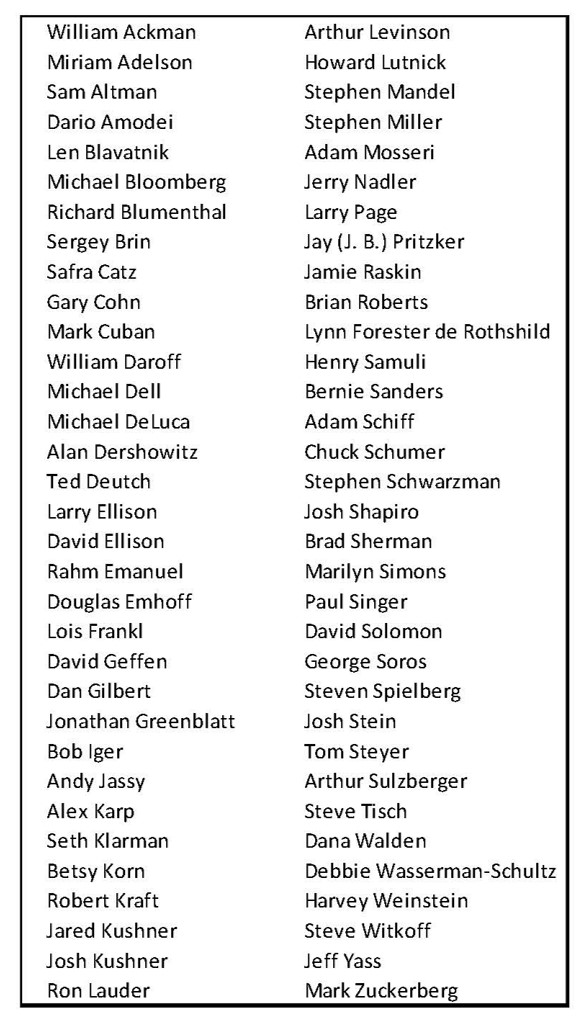
There they are, 66 names: my nominees for the 2026 edition of the new Elders of Zion. Each one guaranteed to work on behalf of Jews and Israel, each guaranteed to put “Jewry first.” I’m sure each reader will have his or her own nominees, perhaps a much larger list; so be it. At least the discussion has begun.

Thomas Dalton, PhD, has authored or edited several books and articles on politics, history, and the Jewish Question. All his works are available at www.clemensandblair.com, and at his personal website www.thomasdaltonphd.com.


[1] There are claims that the Protocols were written as early as 1818, but these are not credible. At least in final form, they must date to the late 1800s—though we cannot rule out that some early ‘proto-Protocols’ were drafted much earlier. The final document mentions Friedrich Nietzsche (Protocol 2) who only came to prominence after 1888; it mentions a French prime minister, Leon Bourgeois (Protocol 16), who served from 1895 to 1896; and it has two textual references to Zionism (Protocols 3 and 5), which did not exist in any meaningful sense until 1897. The final composition was certainly after these dates.

[2] The Jewish “homeland” of Israel would not come into being until 1948, thirty years after the Declaration. For the full story of the “contract with Jewry,” see my book The Jewish Hand in the World Wars (2025).

[3] A UN General Assembly vote, incidentally, has no force of law; that can only come from a Security Council vote, which did not happen. Technically, therefore, Israel was never legally authorized by the UN.

[4] Note that the “King of Israel” is mentioned four times in the text, but there, ‘Israel’ refers to the Jewish people, not the nation-state.

[5] Anthropology (1798/1978), p. 102.

[6] “The Age of Bronze.”

[7] Cited in Marx, “On the Jewish Question,” The Marx-Engels Reader (1978), p. 49.

[8] “Fate,” in Conduct of Life (1860).

[9] “Jewry in Music,” cited in Classic Essays on the Jewish Question (2022), pp. 7-43.

[10] Cited in Classic Essays, p. 64.

[11] Cited in Classic Essays, pp. 95-124.

[12] The Land of Gilead (1880), p. 503.

[13] In The Jew in the Modern World (2011, Mendes-Flohr and Reinharz, eds.), p. 315. Chapter One of Drumont’s book is reproduced in Classic Essays, pp. 125-146.

[14] Essays on the Questions of the Day (1894), p. 260.

[15] One man who did act on it was Henry Ford. He became aware of the Protocols around 1919 and was so impressed that it prompted him to initiate his famous “International Jew” series, which began in May 1920; see my published edition The International Jew: The Definitive Edition (2024; two volumes).

[16] See the white paper “The Jewish Vote,” by Gil Troy (2016).

[17] That is, Protocol #1, cited at page 77 of the above-mentioned edition of 2023.

[18] I won’t elaborate here; for details, see my book Eternal Strangers (2025).

[19] According to Louis McFadden, congressman from Pennsylvania, “Paul Warburg…engineered the Great Depression”—as stated in the Congressional Record of 1931. See One Honest Man (2026; Clemens & Blair).

[20] She is apparently a converted Jew, having married prominent Jew Andrew Stein in 1983 before marrying E. Robert de Rothschild in 2000.

[21] Jews attach much symbolic importance to the number six, so this is an appropriate total.
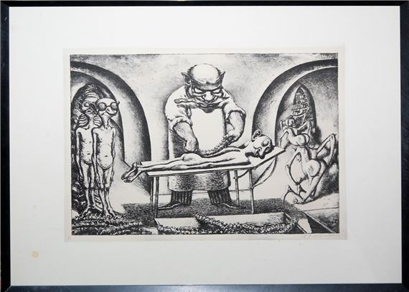
The Concept of the Impolitical

Paul Weber, 1951, “Rückgrat raus!” (Get the Spine Removed!) lithograph
When the political process degenerates into empty palaver—as is the case in the Liberal System—one might rightly call this process “impolitics.” There is no exact English equivalent for the French word “inpolitique,” a term coined by the political sociologist Julien Freund (1921–1993), a close associate of the German legal scholar Carl Schmitt. Widely used in French political theory, the term first appeared in Freund’s remarkable book Politique et impolitique ( 1987) (unfortunately never translated into English). Freund describes it thus: “the apolitical person is external to politics or takes no interest in it, whereas the impolitical person actively participates in political life but lacks judgment or skill in the exercise of his function, because he does not possess the sense of discernment.” One might simply say that impolitical decision-making is wishful thinking resulting in unintended, often catastrophic political results.

Impolitics is just one segment within a broader spectrum of counter-political concepts, including “antipolitics,” “transpolitics,” “infrapolitics,” and “patapolitics”—concepts widely used in French political theory. Beneath the mask of political processes, impoliticians hollow out authentic power politics, replacing them with hired experts preaching unintelligible administrative rules, using doublespeak, and delivering moralizing lectures. Impolitical decision-making among liberal politicians often uses as a cover the euphemism ‘governance.’

Politics implies the strict distinction between friend and foe, while impolitics represents a denial of any enmity. It thrives on grandstanding slogans rather than on a perception of objective political reality. Transpolitics goes hand in hand with impolitics—a term used by the late Jean Baudrillard to signal the end of politics altogether and its relegation to fictitious political scenarios. In books like Fatal Strategies, Baudrillard defines transpolitics through a simple paradox: “Everything is political; therefore, nothing is political anymore.” To this, in our modern digital era, we must add the pathology of ‘patapolitics’—a politician’s obsessive pursuit of imaginary solutions to crises, substituting political reality with algorithms and holograms. Hence the modern surge of self-proclaimed “experts” on social media and podcasts, including countless anonymous semiliterate individuals claiming to have unlocked the doors to the human predicament.

Patapolitics, as a segment of impolitics, captures absurd, imaginary scenarios in which algorithms and video games replace the politician’s search for answers on his cell phone. To cap it all off, impolitics often morphs into antipolitics, which signifies a rejection of the concept of the enemy and rests on the illusion that peace can be enforced by preaching good sermons—a common trait among US/EU leftists and DEI affirmative-action theorists. As Julien Freund points out, the key aspect of impolitics rests on the dangerous illusion that one can escape conflict by shrugging off the concept of the enemy. This is a deadly mistake. I do not need to choose my enemy; he will designate me as his enemy whether I like it or not. To put it more directly and closer to home: I may insist that I am not the enemy of Jews, yet it won’t help me if several Jewish agencies have already labeled me an antisemite. I may walk on all fours or bend over backwards with disclaimers that I am not a racist; it will still do me no good if hostile outgroups or individuals have already labeled me as a racist.

How do our modern politicians fit into the category of impolitics? One might suspect that President Donald Trump embodies to some extent an impolitical phenomenon. Despite the fact that he has strong intentions and undeniably some positive political instincts—such as his pardon of January 6 activists and closing down the border—in foreign affairs he appears trapped in a world crafted by his heroic delusions and/or dishonest advisers. Moreover, his political decisions are driven more by his business mindset than by some knowledge of the classics, ultimately stripping him of any grasp of the historical or political context. Instead, his transactional approach in foreign affairs frequently results in sudden reversals of his initial decisions—leaving both his supporters and his foes stunned, speechless, and searching for meaning.

When impolitics mixes with modern “videopolitics,” fake news floods everywhere—from daily news headlines to history books, especially when loaded with ideological narratives and surreal victimhoods. Add round-the-clock mediatization across a multitude of social platforms, and politics loses its meaning entirely. Politics becomes a farce: a grand spectacle in which mutual trust collapses and careerists and yes-men occupy the halls of power. Unlike sober-faced tragic figures such as Washington, Jefferson, or Bismarck, today’s leaders are perforce nothing more than clowns. On television and social media, they seem more focused on their dental implants than on the promotion of the common good. When one observes the body language of EU commissioners and their counterparts on both the left and the right in local parliaments, the conclusion writes itself: the West is finished—and this also marks the final death knell for the Liberal Order.

One can surely learn more about the danger of liberal impolitics by reading the classics than by studying all the political science treatises. The script of impolitics and patapolitics comes alive in Alice’s journey through Wonderland. Alice’s patapolitical wonderland features absurd rules where official power runs entirely on nonsensical syllogisms. Alice finds herself in a chaotic courtroom where the Knave of Hearts is on trial for stealing tarts. As the King attempts to run the proceedings, the Queen of Hearts completely skips due process and shouts, “Sentence first—verdict afterwards!” This was the author’s unintended blueprint for studying the later Soviet judiciary—and today’s liberal lawfare and its court proceedings against dissidents. This graphic gap between political reality and delusion is best illustrated in the work of German artist Paul Weber. His lithographs mercilessly satirize turncoats, spineless zealots, and citizens falling prey to grandstanding ideas or embracing new dogmas the moment the historical moment becomes ripe. Yet Weber had a hard time: disliked by National Socialist Germany, he was subsequently sidelined and distrusted by post-WWII Anglo-American world-improvers in occupied Germany..

Off, from, and for politics…

This brings up a classic dilemma: Should one trust politicians who live off politics, or those who live for politics? Trump is an idealist of sorts; to his credit, he did not need foreign money to launch his first campaign—unlike countless politicians whose entry into Congress or the EU establishment relies on the financial backing of powerful pressure groups. And in his second term he has transformed into the grifter-in-chief. Without rehashing Max Weber’s century-old theories, the tension between living off or for politics remains as vivid as ever. Many White nationalists and right-wingers—justifiably disillusioned with mainstream political lies—act as idealists fighting for a good cause, though their leaders, once in office, may turn out to be the exact opposite of what they expected. On the other hand, the majority of politicians in the EU and US political arena live off politics. They are opportunists who change their tune the moment a new political-cultural fashion arrives. Yet that very opportunism may offer a strange silver lining: they are less likely to start mass purges when a new order sets in, preferring to rebrand themselves as pragmatic realists.

Sometimes it is good to have a debauched and super-wealthy ruler presiding, because some of his wealth and lax mores may beneficially spill over to the poor. An ultra-modest politician can be lethal. The proto-communist revolutionary and lawyer Maximilien Robespierre lived a frugal, Spartan life, which did not prevent him from launching a widespread and lethal Reign of Terror in France. The nationalist Adolf Hitler was a modest man from a modest Austrian family, a strict vegetarian and early riser, yet his career ended in European chaos. The Roman emperor Marcus Aurelius, a famous Stoic celebrated by modern scholars as the very incarnation of the philosopher-king was known for his honesty and virtue; yet it is likely that Marcus Aurelius carried some recessive criminal genes, which he passed on to his son Commodus, one of Rome’s cruelest and most perverted tyrants. Seneca is still widely praised for his profound Stoic wisdom on moderation, yet his lofty philosophy of Stoicism did not prevent him from becoming the richest man in the Roman Empire.

This glaring contradiction exposes the ultimate all-too-human gap between preaching a multicultural society from an ivory tower and actually living it in real life. The communist Che Guevara lived simply and frugally, refusing personal glory in early revolutionary Cuba, yet his legacy keeps sparking daily Antifa thuggery across Europe and the USA. The list goes on.

When discussing impolitics, one inevitably comes upon great authors such as François de La Rochefoucauld, who observed that “what men call friendship is only a social traffic, a mutual exchange of interests, and a trade in which self-love always expects to gain something.” Much later in America a sharp observer, Ambrose Bierce went even further in denouncing the devilish nature of democracy, defining an elector as “one who enjoys the sacred privilege of voting for the man of another man’s choice.” Following the exhaustion of post-communist transitions in Eastern Europe, the populace is now growing sick of the liberal capitalist experiment and their corrupted elites. A deep current of nostalgia for order and a strong hand persists all over Europe and the US, making it only a matter of time before a breaking point hits us all. But what comes next? Ultimately, what difference does it make when one set of thieves loses their seats if the halls of power are simply refilled with more of the same? Plus ça change…

Return of the Troubles? The New IRA and Its Anti-Immigrant Focus

Anyone who grew up in the British Isles from the 1970s to the 1990s will understand what is meant by “The Troubles” in Northern Ireland, and will know that the IRA stands for the Irish Republican Army. From at least 1969 until 1998, this Catholic paramilitary organization was the leading cause of terrorism in the UK, using bombs, punishment beatings, and targeted assassinations. The IRA were backed by their political masters in Sinn Féin. The name “Sinn Féin” means “ourselves”, or “we ourselves”, and they had common cause with the IRA against the British, particularly in the 1970s. The IRA was routinely referred to as “the provisional wing of Sinn Féin”, often shortened to “the Provos”. Gerry Adams and Martin McGuinness were the famous political figureheads of Sinn Féin, the Reverend Ian Paisley the loudest voice on the Loyalist side. It was a bad time for the Emerald Isle.

Then, this paramilitary outfit began to evolve. The Provisional IRA became the Continuity IRA, then the Real IRA, then broke from the old guard completely in 1997, merging with an organization called Republican Action Against Drugs in 2012 to form the New IRA. This in itself was an interesting merger, as the original IRA were known to raise funds by selling drugs. But the IRA under any name have been fairly quiet since the Good Friday Agreement (GFA) in 1998, at least compared with the height of The Troubles.

The GFA was partly political theater on the part of Tony Blair, keen to be viewed as a peacemaker early into his tenure as Prime Minister. Perhaps he had already planned his “sexed-up” Iraq document on Saddam’s non-existent WMD (which drew the UK into the Iraq War), gauged the likely effect on his legacy, and wished to pre-empt it. But that is for another day. The GFA was hailed as peace in our time but, true to Blair’s signature style of politicking, it is a slippery document.

The GFA knitted three political and geographical bodies together: The Northern Ireland Assembly, the North-South Ministerial Council, and the British-Irish Council. It has kept the peace, more or less, for over a quarter of a century, but that peace is theoretically a fragile one. No one policy instrument defines the role and status of Northern Ireland, but the aggregate legislation states that they have to live together with southern Ireland, or Éire, and the British, and any public disagreement is permissible under the terms of this union of political entities. The aim was union, of course, political if not geographical, but there was a sub-textual purpose to this new triumvirate; to take away the core mission of the IRA and stop the violence. And, despite isolated terrorist incidents, the peace has held. Until now, perhaps.

In July of this year, a 25-year-old law student called Isabella Perrie-Sullivan was arrested by police attempting to cross the Irish border northwards with 25 pounds of explosives in a bag in her car. The arrest was the culmination of intelligence which indicated dissident action following the pattern of that associated with the IRA. The IRA had some of the best bomb-makers in the world. These weren’t Muslims with backpacks that fizzle but fail to explode, or Baader-Meinhof clowns blowing themselves up. These were experts. A bombing campaign with this level of expertise could kill a lot of people. This year, the New IRA have already attacked two Northern Irish police stations with car-bombs. The old Republican mission statement to rid Ireland of the British, and thus to attack Loyalists, is assumed still to be in place, but a new theory as to the New IRA’s intentions in a changed world is slowly forming.

The New IRA may no longer have the British in their sights directly, but instead allegedly have a new target: immigrants. The statistics coming out of Ireland, despite the best efforts of the Irish government to hide or distort them, are sobering. It is estimated that 25% of the population of Éire, are now immigrants. Of the seven women murdered south of the border in the first half of this year, six were killed by migrants. These acts of violence are only part of the story. The Irish are becoming aware that their entire culture is being changed by design. It is becoming apparent with every new atrocity that the Irish are becoming more aware that they are a chapter of the Great Replacement. So, where does the New IRA come in?

The video which has kicked this wasps’ nest purports to be by the New IRA and features another aspect which will alert and alarm the Irish government in that it is not single-issue. The balaclava-clad speaker, flanked by armed comrades, makes it clear that the influx of migrants is their main driver:

 “To the people of Newry, Mourne and Down: we, the New Republican Movement, have watched our councillors and MLAs over the past 12 months.

​“The level of disrespect shown to the people who put you into power, this cannot be ignored any longer.

​“We are proud men of Ireland, we are patriots.

“Your policies and decision-making regards to flooding our communities with undocumented military-aged men is not acceptable.

​“We will not sit back any longer and watch our culture and religion destroyed by the people we put in power.

​“Also the sexual indoctrination of our children in schools has not went unnoticed either.

​“The New Republican Movement will take immediate action against anyone who threatens our way of life and the safety of our women and children.

​“We have your addresses and know your movements.

“Every one of you are legitimate targets as of today.

“The New Republican Movement, 28th of the 11th, 2025.”

It comes weeks after a video was circulated on X purporting to show a different Irish republican right-wing group, the Irish Citizen Army, which also depicted three men in front of a tricolour delivering a similar anti-immigration message.

“Andrew” posted a video on August 3. He is an ex-intelligence operative who speaks of the reputation the IRA had with the British Army, who saw them as “not just formidable, but unbeatable”. As with all major terrorist groups, the IRA were a many-headed hydra which presented the British Army with two major and paradoxical problems. Arrest or kill them and they create martyrs to the cause, powerful fuel for terrorists. Read the story of hunger-striker Bobby Sands, who died in 1981. Fail to stop the “Rah”, as the IRA were known colloquially, and the bombs keep going off. A top IRA operative once famously said that, while the British needed to get lucky every day to stop the Republicans, the IRA only had to get lucky once. The IRA’s soldiers were known to be efficient, ruthless, and incredibly violent. If they turn their attentions to migrants, it will be the worse for those who supposedly “just want a better life”.

Cynics might suggest that the IRA attempting to rid Ireland of migrants the way St. Patrick was said to have cast out the nation’s snake population serves a further purpose, and this concerns the British. Any migrants forced out of Ireland can only go to mainland Britain, unless the people-smuggling gangs have an inflatable which will make it across the Atlantic. They are likely to stay there. This will appeal to those in the New IRA who retain the animus of the old IRA, as it will put England in particular in the grip of a pincer movement of immigration. Events in the autonomous Spanish city of Ceuta, which has become a holding-pen for tens of thousands of immigrants wanting to enter mainland Europe, is another threat to the UK, as many of those migrants want to get to Britain. Recently, some would go on to Northern Ireland, walk across the porous and largely unguarded border to the south, and thus re-enter the Schengen Zone of the EU. If this border becomes manned by men in balaclavas carrying AK-47s, it would no longer be a viable route. These men would be unlikely to have had much DEI training, but they will know how to shoot to kill.

The return of the IRA would put the Irish government in a precarious position. Having shown themselves unwilling to take action against migrant criminals, if they suddenly took swift decisive action against actual Irishmen, they run the risk of starting a genuine civil war. But if they back off, they run a different type of risk, that age-old religious divisions might heal, or at least hostilities may be suspended. Then, if the wider populace sees that the IRA are expelling immigrants where the government clearly had no intention of doing so, that is a powerful win for the Republicans.

All of this could be a hoax, a ruse, or the work of mischief-makers. But the Irish government will know that it could be the real thing and, even if the New IRA is not planning to target migrants, it may inspire others to do so. The recent near-decapitation and blinding of a disabled man in Belfast, allegedly by a Sudanese immigrant, led to nights of rioting reminiscent of 1969, when Catholics and Protestants fought each other and the PSNI (Police Service Northern Ireland). Syndicated news sources wrote that “The New IRA are plotting to capitalize on tensions around migration and could use the anxieties to launch an intimidation campaign against vulnerable communities”. The way this is framed implies that these anxieties and tensions are somehow groundless but evades the obvious point that it is the native Irish who are currently feeling like a vulnerable community. Irish YouTubers such as No Risk No Reward, County Gains, Derek Domino, and Peter Dooley Dublin report on almost daily attacks and sexual assaults on Irish people.

The phrase “the fighting Irish” is well-founded. From the battles of 1916, Michael Collins and his colleagues, and The Irish Citizen Army, Irishmen — and women — will not simply roll over as the populations of Europe have done, and a possible knock-on effect of any anti-migrant action taken by the New IRA will be giving British government ministers sleepless nights. The British may be inspired by any Republican action and follow suit. Danny Tommo is an anti-immigration activist reportedly holding training camps for young, White, Englishmen, and is actively recruiting. Despite the government’s boast that it is moving immigrants out of hotels, these military-age men are actually being moved into disused army facilities. They are, quite literally, being barracked.

In many ways, parts of England are now under occupation every bit as real as that which inspired the Irish Republican Army. There may be no troops on the streets of London or Birmingham, and armored patrol vehicles are nowhere to be seen, at least not yet. But shops are filling high streets which are clearly being used to launder money, pubs and churches are closing, with many having been the subject of planning applications and intended to become mosques, and ever-increasing crime, particularly against women (almost unbelievably, an elderly was allegedly raped recently in the UK by a migrant). Occupation by an invading force creates resistance — a historical given. In middle-class areas, to which the government is turning to house illegal immigrants, many of whom no one knows anything about, the British government know that a few hundred residents in a leafy village will offer no resistance. They will be middle-class and probably voted Green or Liberal Democrat, so Labour are in no danger of losing votes by enraging the locals.

The new British Prime Minister, Andy Burnham, is already proving that, when it comes to word salad, he is a master-chef. The phrase “political rhetoric” is regularly misused in the UK media to mean “language” or “vocabulary”, but classical rhetoric was far more sophisticated than simply explaining how to use a dictionary. Rhetoric deals with how language is employed in order to obtain desired effects in the audience. Aristotle puts it most clearly in his Rhetoric:

It is clear, then, that rhetorical study, in its strict sense, is concerned with the modes of persuasion.

Burnham has so far managed to avoid serious press scrutiny, but on the rare occasions he is pinned down, what comes out of his mouth — apart from lyrics by The Smiths — is pure filler. The art of political speaking now is largely concerned with how to take up time while saying nothing of substance, and Burnham has this down to a fine art. Here is an excerpt from a recent interview, in which the PM is asked about the concerns of residents in a small English town called Piddington, population around 350, who are about to have a migrant camp housing 1,200 young Muslim men placed in the center of a town so small it still qualifies as a “hamlet”:

Well, I have begun to become aware of the campaign in Piddington, and I am absolutely prepared to meet Rex [a seven-year-old boy who wrote to the PM warning of the effects of the new camp].  I will listen to what people are saying and respond to the concerns they are putting forward. I don’t know the issue yet in detail, but in some ways, as I understand it, it is about creating a secure space. … It’s obviously going to be challenging, but I am prepared to listen…

On and on it goes, and I won’t subject you to all of it. It is meaningless drivel dressed up as managerial expertise. But there was one short section that repays inspection:

We cannot have a situation where it’s only the poorest communities in the country that receive all of the dispersal of refugees and asylum-seekers. I do believe all parts of the country need to work to play their part. It’s a challenging issue … and I will look into the issues for the good people of Piddington.

Play their part. It’s almost as though this was a dramatic production, complete with writer and director. Anna Turley is the Government Minister responsible for the invasion force still referred to as “asylum seekers”. As with almost all politicians, she is keen to tell us what her government’s policy is “about”, and Burnham’s stated intention to disperse immigrants to small rural areas is apparently “about fairness”. Small, tightly knit white communities must, she says, take their “fair share” of aggressive, military-age Muslim men, some of whom statistically will be rapists and murderers. We are all aware of what fairness is: equality of opportunity, where appropriate and conducive to the social good. Freedom for all, for example, seems fair, but if that extends to violent criminals, then it becomes unfair to those put at risk by the freedom of those with a predisposition to violence. That is another subject, and no less relevant than immigration, but the idea that there is a “fair share” in terms of violent invaders — often placed near children’s schools — will be difficult for the “good people of Piddington” to process.

Burnham also mentions that he will “address legitimate concerns”, implying that there will be illegitimate concerns. These will probably take the form of social media commentary for which even more White English people will be jailed. But although Burnham has buried his core message in meaningless verbal slop, what he has said is very important for its inevitable consequences. The peasants have revolted before in England, and I refer you to 1381. Now it may be time for a middle-class revolution, and it may be that violent action taken by an Irish band of men everyone thought had faded into history could convert an awful lot of people to the idea of direct action.

The British government has just extended contractual arrangements with various property companies which will ensure that immigration will continue until 2039. There are two important implications of this long-term plan. The first is the simple economic pledge. Immigration is costing the UK a fortune. Many fortunes. What will the compound be like 13 years hence? Secondly, this is more deliberate provocation. And the action of provocation often produces an equal and opposite reaction.

There might be a name for the toleration of illegal violence if it serves to protect ordinary people. London’s most notorious criminals, the Kray Twins, were loved by many residents in the east end of London because they kept peace on the streets and in the houses. They protected ordinary people from crime in a way the police could not do. A burglar today would not think twice today about breaking and entering, not with the state of British policing. But if they knew that Ron and Reg would staple their hands to a snooker table with kitchen knives if they caught them, it’s a lot more of a deterrent than a suspended jail sentence. If the New IRA can provide the same level of violent, ruthless protection to the ordinary, innocent white Irish, they may become just as revered. In Dublin, there are migrants in tents camped beneath statues of Irish rebel heroes who fought for Irish freedom, and these symbolic occupations are not going unnoticed.

One of many ironies about this simmering situation is the role of Sinn Féin. Affiliations have changed since the IRA were known as the “provisional wing” of the party. One nickname for the IRA was “the Provos”. Now, Sinn Féin are all for unlimited immigration, and they have gone from being the IRA’s effective employer to being the enemy. They will be nervous, as the IRA didn’t just blow up random civilians and kneecap informers with power-tools. They killed MP Airey Neave and Lord Mountbatten, then five more people in 1984 — including another MP — at Brighton Hotel in an attempt to kill Margaret Thatcher. Also in 1984, the IRA famously bombed Harrod’s, London’s famous department store in which I was working at the time the 80lb car-bomb went off, killing six (including three police officers) and wounding 86 others.

The Troubles were one of the ugliest chapters in Irish history, and there were violent and ruthless men both on the Republican side, and that of their Loyalist/British enemy. My father was a documentary filmmaker for The Ministry of Defence in the 1970s. Filming in Belfast, he was spoken to by an SAS commander and given clear rules as to what he could and could not record. He pointed at Dad’s cameraman’s equipment, then patted his own Armalite rifle. “If that goes off in my direction”, he said, “this goes off in yours”. What may be coming may not be The Troubles 2.0, but it may trigger something equally violent.

Secret Semitic Censorship: How a Miniature Masterwork Was Perhaps Muzzled by Metus Judæorum

“If you read it once, you’ll remember it for ever.” I can’t say that of most short stories I’ve read. But I can definitely say that of “What Was It?” (1859). It’s the most famous story by the boozing and brawling Irish-American writer Fitz-James O’Brien (1826-62). In a few thousand words, O’Brien wove deep mystery, tragedy and horror around an alien creature with only three certain characteristics. Two of them are that it’s humanoid and malevolent. And what is the third? Well, that’s described by the narrator after he’s attacked by the creature one night in “the most profound darkness” of a bedroom. In a fierce struggle he manages to subdue it. And then, naturally enough, he wants to see what’s attacked him:

Never losing my hold for an instant, I slipped from the bed to the floor, dragging my captive with me. I had but a few steps to make to reach the gas-burner; these I made with the greatest caution, holding the creature in a grip like a vice. At last I got within arm’s-length of the tiny speck of blue light which told me where the gas-burner lay. Quick as lightning I released my grasp with one hand and let on the full flood of light. Then I turned to look at my captive.

I cannot even attempt to give any definition of my sensations the instant after I turned on the gas. I suppose I must have shrieked with terror, for in less than a minute afterward my room was crowded with the inmates of the house. I shudder now as I think of that awful moment. I saw nothing! Yes; I had one arm firmly clasped round a breathing, panting, corporeal shape, my other hand gripped with all its strength a throat as warm, and apparently fleshly, as my own; and yet, with this living substance in my grasp, with its body pressed against my own, and all in the bright glare of a large jet of gas, I absolutely beheld nothing! Not even an outline,—a vapor! (“What Was It?,” 1859)

Yes, the creature is humanoid, malevolent, and completely invisible. This is the first appearance of a literary trope that would be taken up by much more famous authors in much more famous works like H.G. Wells’ novel The Invisible Man (1897) and Guy de Maupassant’s short-story “Le Horla” (1887). Maupassant died tragically young like O’Brien himself and like Edgar Allan Poe, a big influence on O’Brien. But Maupassant and Poe have never lost the huge fame they acquired in their short lives. O’Brien wasn’t hugely famous even during life and might be forgotten now if it weren’t for three miniature masterworks, his three best short-stories. The first and most famous is “What Was It?,” followed by “The Diamond Lens” (1858) and “The Wondersmith” (1859).

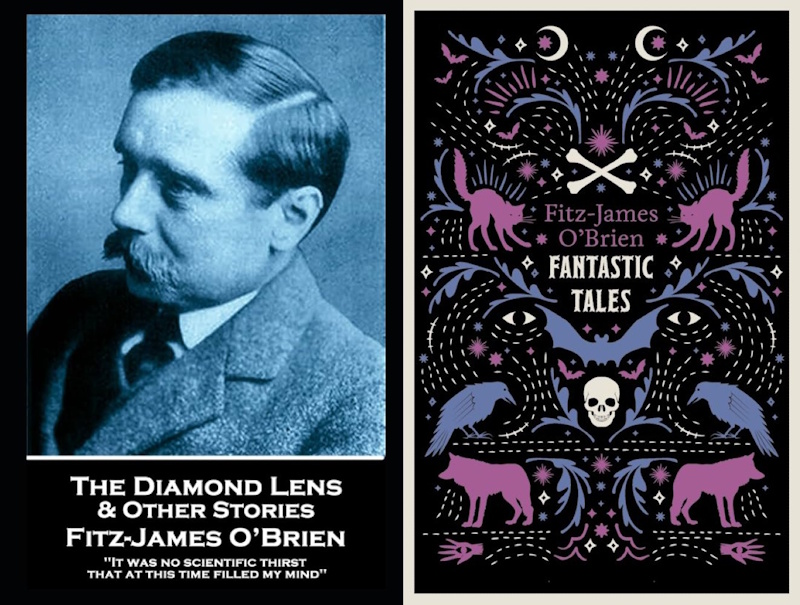
Books by a boozing brawler: Two collections of Fitz-James O’Brien’s stories


Those three stories continued to appear in anthologies and genre collections, keeping O’Brien’s name alive down the decades. But I’d read only “What Was It?” when I picked up Fantastic Tales, a welcome new collection of O’Brien’s stories published in 2025. Now I’ve read and rated “The Diamond Lens” and “The Wondersmith” too. How did I rate them? Well, “The Diamond Lens” is in some ways even more imaginative and memorable than “What Was It?.” It’s about another strange and symbolically seductive creature. But this one is beautiful, not malevolent, and appears not in a dark bedroom but in a drop of water.

I won’t say any more, because I recommend that you read the story for yourself and see how Fitz-James O’Brien is much less famous than he deserves to be. But I will say more about O’Brien’s story “The Wondersmith,” because I think it’s an example of something that’s also much less famous than it deserves to be. Or rather: much less infamous than it deserves to be. And what is that? It’s what you might call S.S.C. — Secret Semitic Censorship. The full story of Jewish censorship has never been told and never will be, because most of it has taken place in secret and without publicity. Jewish gatekeepers in journalism, publishing, academia and politics have squashed stories, suppressed facts, silenced crime-thinkers long before the gentile general public could glimpse the toxic truth. But even more Semitic censorship may have been indirect, carried out not by Jews themselves but by gentiles intimidated by metus Judæorum.

Lost in mistranslation

Metus Judæorum is a Latin phrase that strikes a repeated ominous note in the Evangelium secundum Johannem or the Gospel of John. In rather earlier Greek it runs ὁ φόβος τῶν Ἰουδαίων, ho phobos tōn Ioudaiōn, and in much later English it runs like this:

7:13 Howbeit no man spake openly of him for fear of the Jews.

19:38 And after this Joseph of Arimathaea, being a disciple of Jesus, but secretly for fear of the Jews, besought Pilate that he might take away the body of Jesus.

20:19 Then the same day at evening, being the first day of the week, when the doors were shut where the disciples were assembled for fear of the Jews, came Jesus and stood in the midst, and saith unto them, Peace be unto you. (See The Gospel of John at Bible Hub)

Ironically enough, some modern translators of the New Testament are motivated by ho phobos tōn Ioudaiōn when they mistranslate that very phrase as “fear of the Jewish leaders” and “fear of the Jewish authorities” or the even weaselier “fear of the leaders” and “fear of the authorities.” Jews have long condemned the New Testament as “anti-Semitic” and blamed it for inspiring the millennia of persecution and pogroms that culminated in the horrors of the Holocaust. That’s why they’ve striven mightily to replace Christianity with Israelism and Holocaustianity, and that’s why modern translators are frightened to translate simple Greek as equally simple English.[1]

A Christophobic Conspiracy

But it could be worse for Jews. Linguistic change has obscured in English a clear and obviously deliberate connection made by the Gospel in Greek and Latin, where “Judas” and “Jews” are Ioudas / Ioudaioi and Judas / Judæi, respectively. In the Gospel of John, malevolent, demon-driven Judas is meant to personify the malevolent, demon-driven Jews. That was in the 1st century A.D. But you can find the same themes – metus Judæorum, “fear of the Jews,” and malevolentia Judæorum, “Jewish malevolence” – in the 19th century A.D. and Fitz-James O’Brien’s story “The Wondersmith.” Or rather, you can’t find them, because the metus has censored the malevolentia. That’s what I’d claim, anyway. See if you agree with my reasoning.

“The Wondersmith” is a highly imaginative and logophilic story of a conspiracy to defile Christmas and kill Christian children using magically animated toys with poisoned weapons. Does that conspiracy sound Jewish to you? It does to me. The chief conspirator is the Wondersmith of the title, who owns a shop in the Lower Manhattan district of New York. He’s called Herr Hippe and has three co-conspirators: Kerplonne from France, who’s a maker of artificial eyes; Madame Filomel, a fortune-teller also from France; and Oaksmith from England, whose profession is never revealed. The four conspirators belong to the same alien race, which is mentioned by Herr Hippe when he gloats over their conspiracy and the “manikins” he has made to fulfil it:

“I long to test them,” cried the Wondersmith, rubbing his hands joyfully. “I long to see how the little devils will behave when I give them their shapes. Ah! it will be a proud day for us when we let them loose upon the cursed Christian children! Through the length and breadth of the land they will go; wherever our wandering people set foot, and wherever they are, the children of the Christians shall die. Then we, the despised Bohemians, the gypsies, as they call us, will be once more lords of the earth, as we were in the days when the accursed things called cities did not exist, and men lived in the free woods and hunted the game of the forest. Toys indeed! Ay, ay, we will give the little dears toys! toys that all day will sleep calmly in their boxes, seemingly stiff and wooden and without life,—but at night, when the souls [supplied by black magic] enter them, will arise and surround the cots of the sleeping children, and pierce their hearts with their keen, envenomed blades! Toys indeed! oh, yes! I will sell them toys!” […]

“Good!” cried Kerplonne, rubbing his hands joyously. “It is close upon New Year’s Day. We will fabricate millions of the little murderers by New Year’s Even, and sell them in large quantities; and when the households are all asleep, and the Christian children are waiting for Santa Claus to come, the small ones will troop from their boxes and the Christian children will die. It is famous! Health to Abigor!”[2] (“The Wondersmith”, 1859)

So the four conspirators are described as “gypsies” in the story. But they’re not behaving or talking like Gypsies. No, they’re behaving and talking like Jews. First of all, Gypsies were not prominent in the United States at the time of the story and especially not in New York. But Jews were prominent, especially in New York. Further, the hand-rubbing Herr Hippe and Kerplonne are educated and eloquent (the “Abigor” saluted by Kerplonne is a pseudo-Hebraic “demon of soldiery” in medieval magic). Gypsies were not associated with education and eloquence. But Jews were. Okay, Gypsies were indeed associated with fortune-telling and black magic like Madame Filomel, but Jews too were associated with black magic. Gypsies had never been associated with shopkeeping, manufacture and commerce like Herr Hippe and Kerplonne. Jews were certainly associated with those three things. There was no tradition in Europe or America about Gypsies despising Christianity and seeking to murder Christian children.[3] But there was certainly a tradition of that about Jews. And there was no tradition about Gypsies using poison and subterfuge against their enemies. But again, there was certainly a tradition of that about Jews. Finally, the megalomaniacal claim to be once and future “lords of the earth” was not associated with Gypsies. But it was certainly associated with Jews (and still is). Here’s some more from “The Wondersmith,” a description of the conspirators poisoning the toys, then gloating over the coming slaughter:

The anointing of the [toys’] swords [with deadly poison] went on rapidly, and the wine went as rapidly down the throats of the four poisoners. Their faces grew more and more inflamed each instant; their eyes shone like rolling fireballs; their hair was moist and dishevelled. The old fortune-teller rocked to and fro in her chair, like those legless plaster figures that sway upon convex loaded bottoms. All four began to mutter incoherent sentences, and babble unintelligible wickednesses. Still the anointing of the swords went on.

“I see the faces of millions of young corpses,” babbled Herr Hippe, gazing, with swimming eyes, into the silver bowl that contained the Macousha poison,—“all young, all Christians,—and the little fellows dancing, dancing, and stabbing, stabbing[!]” (“The Wondersmith”)

The Christophobia and gloating do not sound Gypsy: they sound Jewish. Gypsies were associated with petty theft, not with grand conspiracies to slaughter Christians and rule the world. Nor were Gypsies associated with the destruction of beauty and the cruel killing of animals. But Jews were associated with both and the conspirators in “The Wondersmith” want to test the murderous manikins. So they sneak into the shop of a goy called Pippel and set the manikins loose on his stock. Pippel is a bird-fancier from Germany and this is what his shop looks like before the conspirators have taken great satisfaction in “[saving] alive nothing that breatheth” there:

It was a little world of birds. On every side, whether in large or small cages, one beheld balls of various-colored feathers standing on one leg and breathing peacefully. Love-birds, nestling shoulder to shoulder, with their heads tucked under their wings and all their feathers puffed out, so that they looked like globes of malachite; English bullfinches, with ashen-colored backs, in which their black heads were buried, and corselets of a rosy down; Java sparrows, fat and sleek and cleanly; troupials, so glossy and splendid in plumage that they looked as if they were dressed in the celebrated armor of the Black Prince, which was jet, richly damascened with gold; a cock of the rock, gleaming, a ball of tawny fire, like a setting sun; the Campanero of Brazil, white as snow, with his dilatable tolling-tube hanging from his head, placid and silent;—these, with a humbler crowd of linnets, canaries, robins, mocking-birds, and phoebes, slumbered calmly in their little cages, that were hung so thickly on the wall as not to leave an inch of it visible.

“Splendid little morsels, all of them!” exclaimed Monsieur Kerplonne. “Ah, we are going to have a rare beating!” […]

“Come,” said the Wondersmith, producing the box of manikins, “get ready with souls, Madame Filomel. I am impatient to see my little men letting out lives for the first time.” (“The Wondersmith”)

Pippel from Germany loves and nurtures birds; Herr Hippe, also from Germany, despises and kills birds. Is Pippel meant to represent goyim and Hippe Jews? After all, Pippel sounds like “people” and goyim literally means “peoples,” being the plural form of Hebrew goy, “a non-Jewish people or race.” A logophile like Fitz-James O’Brien would surely have known that. I can’t see any obvious parallel wordplay in the name Hippe, but it does remind me of “hip-hooray,” which comes from earlier “hep-hooray.” Apocryphally, “Hep! Hep!” was the cry of the Christian mobs that attacked Jewish ghettos in the Middle Ages and later. It was supposed to be an acronym for Hierosolyma Est Perdita, “Jerusalem Is Lost” – that is, lost to Christians by Jews conspiring with Muslims.

Again, Fitz-James O’Brien very probably knew that story about the origin of “Hip-hooray.” He certainly knew the origin of the word “ghetto,” as he makes clear in the opening paragraph of “The Wondersmith.” That’s where he describes the scene of Herr Hippe’s shop and the Christophobic conspiracy:

A small lane, the name of which I have forgotten, or do not choose to remember, slants suddenly off from Chatham Street [in Lower Manhattan], (before that headlong thoroughfare reaches into the Park,) and retreats suddenly down towards the East River, as if it were disgusted with the smell of old clothes, and had determined to wash itself clean. This excellent intention it has, however, evidently contributed towards the making of that imaginary pavement [the highway to Hell] mentioned in the old adage; for it is still emphatically a dirty street. It has never been able to shake off the Hebraic taint of filth which it inherits from the ancestral thoroughfare. It is slushy and greasy, as if it were twin brother of the Roman Ghetto. (“The Wondersmith”)

The “Roman Ghetto” was the Jewish district in Rome, named after the Jewish ghetto in Venice. And I think that O’Brien’s opening paragraph is like the “gills” on a human embryo.[4] It’s an unmistakable clue to what was originally there: the development of the embryo into a fish; the expansion of “The Wondersmith” into a story about Jews, not about Gypsies. If the story was originally about Gypsies, why did O’Brien set it in a district of New York strongly associated with Jews? And why did he describe the district as smelling old clothes at a time when Jews were associated with selling used clothing? Why did he talk about the Jewish district of Rome and the “Hebraic taint of filth”? It doesn’t make sense. But it makes perfect sense if the story was originally about Jews and then re-written to be about Gypsies. The opening paragraph also makes perfect sense if O’Brien wanted to tell his readers Lisez le blanc, lisez ce que je n’ai pas écrit et ce qui y est pourtant — “Read the white, read what I did not write and what is there nonetheless.”

Creditors and editors

After all, O’Brien was certainly anti-Semitic. How else do you explain a phrase like “the Hebraic taint of filth”? That taint is inherited “from the ancestral thoroughfare,” the street where Jews specialized in the used-garment trade in New York just as they did in London and Paris. I think O’Brien was using streets as symbols: the “ancestral thoroughfare” is the ancient Jewish hatred of Christians and Christianity, which is still active in the off-slanting “lane” of the Jewish presence in contemporary America.

But O’Brien was doubtless well-acquainted with Jews long before he lived in America. He was born in County Cork, Ireland, then lived in London and likely visited Paris several times to use his fluent French. Having squandered his large inheritance, he next set off to find fame and new fortune in America. He did win some fame as a writer but never made a second fortune. He was born Irish and remained faithful wherever he roamed to the great Irish traditions of boozing and brawling. Michael Hayes, the editor of the new collection of O’Brien’s stories, describes what happened after O’Brien arrived in America in 1851:

In the next eleven years, O’Brien was to produce a mass of writing — poetry, plays, stories, essays, satires, criticism and journalism. He had to. He invariably lived beyond his means, often drank to excess, borrowed from Peter to pay Paul, and generally led a Bohemian existence. He dashed off stories and poems to settle his rent and placate impatient creditors. Hard times were his constant companion. It was also said that you were not considered his friend unless he had fought with you. In fact, he was kind to an extreme, well loved and a lively, amusing companion — at times truculent, at other times gentle and delightful. He never failed to enjoy a good fight. (Fantastic Tales, Fitz-James O’Brien, Alma Classics 2025, introduction by Michael Hayes, p. viii)

It’s highly probable that those “impatient creditors” included some Jews. And Jews almost certainly edited some of the magazines and newspapers O’Brien wrote for. If so, O’Brien may have reacted to Jewish creditors and editors like many writers before him and since: with distaste, irritation, and a desire to get his own back by satirizing Jews in print.

A Fantastic Fraction

Charles Dickens was one of the earlier writers who reacted like that to Jews, as I’ve described in “Minority Malice: The Curious Case of Daniel Quilp.” Saki and M.R. James were two of the later writers, as I’ve also described at the Occidental Observer. But have I described the same kind of writer in this article? Was “The Wondersmith” really aimed by Fitz-James O’Brien at Jews?

I believe it was and I’d predict there’s more hating on Hebrews by O’Brien in the “mass of writing” mentioned in that introduction to Fantastic Tales. Only a fraction of his writing is collected in the book, but the fraction proves that O’Brien was a very good writer and strongly suggests in “The Wondersmith” that he knew the Jew. So I heartily recommend Fantastic Tales to any aficionado of fantasy and horror. What’s true of “What Was It?” is true of the whole book: If you read it once, you’ll remember it for ever.


[1] Well, I say “simple Greek,” but in fact Ioudaioi doesn’t mean what “Jews” has come to mean. For further discussion, please see my article “Survival or Suicide: Italy Will Follow Meloni’s Melody, not the Schlein Whine.”

[2] Abigor is a powerful demonic entity primarily documented in the 16th and 17th-century grimoires (most prominently those related to the Solomonic tradition). He is a Great Duke of Hell who commands up to 60 infernal legions. The demon is typically associated with the power to foretell the future (especially in war) and to secure favor with military commanders. That’s why his counsel was explicitly sought in matters of war and generalship. He is also one of the demons that grant command and bestow martial knowledge upon the summoner.

[3] Gypsies were rumored to steal non-Jewish children, not murder them.

[4]  Strictly speaking, the “gills” on an embryo are pharyngeal arches. But they look like gills and would have developed into gills in our piscine ancestors.

The Hellenistic Origin of the Torah — A Review of Russell Gmirkin’s Books, Part 4 of 4: Cosmic Monotheism and the Timaeus

Go to Part 1.
Go to Part 2.
Go to Part 3.

Yahweh the Son of El

The most ancient version of the Hebrew Bible that we have, the Masoretic Text, was edited between the 7th and the 10th centuries ad. The Greek version known as the Septuagint, made around 170 bc, shows internal evidence of having been translated from a different Hebrew original that is lost. Some parts of that Hebrew original are found in the Dead Sea Scrolls discovered in the middle of the twentieth century. For example, one fragment from the manuscript referenced as 4QDeuteronomy, dated to the 1st century bc, gives this reading for Deuteronomy 32:8–9:

When the Most High (Elyôn) gave to the nations their inheritance, when he separated humanity, he fixed the boundaries of the peoples according to the number of the sons of God (bene Elohim). For Yahweh’s portion is his people, Jacob his allotted heritage.

The Masoretic text has “sons of Israel” (bene Yisrael) instead of “sons of God”, which makes little sense. The Septuagint has “angels of God” (aggelon theou), which is a standard Greek translation for “sons of God.” Bible translators today agree that “sons of God” is the original reading, although they generally place it in a footnote.

The original Deuteronomy 32:8–9 casts Yahweh in the role of one of the sons of El, here called Elyôn. Each of El’s sons receives one nation, and Yahweh receives Israel. According to Old Testament scholar Mark S. Smith, author of The Early History of God (first published in 1990), this reflects an ancient conception that was not specific to Israel, but echoes an ancient theology of the Near East. Some of the Ugaritic texts written in northern Syria in the 13th and 12th centuries bc, and discovered in 1928, call the supreme god El, and the other gods “sons of El.”

Some of the oldest Psalms preserve that ancient conception of a cosmic god El assisted by his offspring for terrestrial matters, and of Yahweh as one of those “sons of El.” In Psalm 82 the supreme God presides over a great assembly: “in the midst of the gods (elohim) he holds judgement, telling them ‘you are gods [elohim], sons of the Most High [elyown], all of you.’” Other psalms present Yahweh as one of the sons of God (bene elim), albeit the best of them: “Give Yahweh his due, sons of God, give Yahweh his due of glory and strength” (Psalm 29:1);  “Who in the skies can compare with Yahweh? Who among the sons of God can rival him?” (Psalm 89:6).

According to Smith, the “el” in Israel “suggests that El was the original chief god of the group named Israel.”[1] Judah, on the other hand, is linguistically connected to Yahweh. Before being imported from Judea to Israel (Samaria), Yahweh probably originated from the land of Midian in northwestern Arabia, as remembered in the book of Exodus (read here): Moses met Yahweh in a “holy ground” (3:5) while herding the goats of his father-in-law, who was a Midianite priest (2:16 and 18:1), who “offered a burnt offering” to Yahweh (18:12), and who instructed Moses on how to organize the tribes (18:19–25). It was Moses’ Midianite wife Zipporah who performed circumcision on their newborn son, to appease Yahweh’s wrath (4:24–26).

How Israel was “converted” to the cult of Yahweh is told in 2Kings 10: in 842 bc a Judean general by the name of Jehu overthrew King Omri of Israel, and slaughtered “all his leading men, his close friends, his priests; he did not leave a single one alive” (10:11). His religious “reform” consisted in luring the priests of Baal for “a great sacrifice to Baal,” and slaughtering them (10,18–28).

The process of merging Yahweh with El, thus promoting Yahweh from national god to cosmic Creator, took much longer. In the 8th century bc, Yahweh is still described as just a national god in Micah 4:5: “For all peoples go forward, each in the name of its god (elohim), while we go forward in the name of Yahweh our God for ever and ever.” In Judges 11:24, the Israelites declare to the Moabites: “Will you not keep as your possession whatever Chemosh, your god, has given you? And, just the same, we shall keep as ours whatever Yahweh our god has given us, to inherit from those who were before us!”

Before Yahwistic monotheism, historians of Israel identify a stage of Yahwistic monolatry, meaning the exclusive worship of Yahweh while acknowledging the existence of other gods. This is when Yahweh became the “jealous god”—his jealousy implying the existence of other gods—and the cult of other gods assimilated to adultery or prostitution, as in Exodus 34: 11–16:

Observe what I command you this day. Behold, I will drive out before you the Amorites, the Canaanites, the Hittites, the Perizzites, the Hivites, and the Jebusites. Take heed to yourself, lest you make a covenant with the inhabitants of the land to which you are going, lest it become a snare in the midst of you. You shall break down their altars, and break their pillars, and cut down their asherim (for you shall worship no other god, for Yahweh, whose name is jealous, is a jealous God), lest you make a covenant with the inhabitants of the land, and when they play the harlot after their gods and sacrifice to their gods and one invites you, you eat of his sacrifice, and you take of their daughters for your sons, and their daughters play the harlot after their gods and make your sons play the harlot after their gods.

“The passage asserts four points about Israel,” comments Mark Smith in The Early History of God. “First, Israel’s ethnic identity was originally separate from other peoples of the land. Second, Israel was not originally among the peoples in the land. Third, specific cultic objects were alien to Israel. Finally, Yahweh was the only deity of Israel.” Exodus is here warning the Israelites against syncretism. But, Smith argues, since we now know that the conquest of Canaan is a literary construction, the Exodus narrative must be read as an inversion of the historical process: “the process of the emergence of Israelite monolatry was an issue of Israel’s breaking with its own ‘Canaanite’ past and not simply one of avoiding ‘Canaanite’ neighbors.”[2]

The aggressive monolatry of the jealous god is hardly compatible with the ancient Near Eastern notion of a “council of the gods” (as I mentioned earlier, some Egyptians recognized the god of the Jews as Seth, the evil god banned from the council of the gods). The shift from monolatry to monotheism is easy to implement: when the people are only allowed to worship one god, they are easily persuaded that this god is the only real god, and therefore God. As Mark Smith remarks: “if ancient Israelite religion is to be viewed primarily as a matter of practice, then the modern distinction between monotheism and monolatry is problematic.”[3]

The explicit identification of Yahweh with the supreme God El, was conceptualized during the Hellenistic period, and probably even finalized in the Hasmonean kingdom: “I am Yahweh who created the heaven and the earth,” we read in the Book of Jubilees (32:18), a text of Hasmonean propaganda affirming the supranational destiny of Israel.

Russell Gmirkin quotes abundantly from Mark Smith in his third and last book, Plato’s Timaeus and the Biblical Creation Accounts: Cosmic Monotheism and Terrestrial Polytheism in the Primordial History (Routledge 2022): His main thesis is that “Jewish monotheism was first introduced at a relatively late date, in the early Hellenistic Era, under the influence of Plato’s Timaeus.”[4] He is not the first scholar to tread on this path,[5] but he has perfected the comparative analysis between the cosmogony of Genesis 1 and the cosmogony of Plato’s Timaeus. In my view, however, the most interesting part of his book is not the comparative arguments, but rather Gmirkin’s perspective on the development, from the Presocratics to Plato, of a Greek theology combining “Cosmic Monotheism and Terrestrial Polytheism.”

Because the Abrahamic religions define themselves as monotheism, they define the religions they supplanted as polytheism. This is a polemical perspective that historians are now challenging. Two collections of essays have recently been devoted to “pagan monotheism”, published respectively by Oxford UP and Cambridge UP.[6] John North writes in One God: Pagan Monotheism in the Roman Empire: “throughout the classical period and far earlier in the Near East, monotheistic assumptions are quite commonly found, without apparently raising any fears of weakening polytheistic practice.”[7] Such a concept of the divine realm as a “family of gods” (a cosmic god and his terrestrial offspring), or as one God in multiple forms, may be called “inclusive monotheism”, and contrasted with the Jewish “exclusive monotheism” that rejects the existence of any god but the supreme God. As we saw above, that exclusive monotheism is the result of promoting “Yahweh the god of Israel” to the throne of the supreme creator of heaven and earth. The jealous god ends up negating the very existence of all his competitors, thereby affirming that he is the only real god, and is therefore God. Yahweh’s promotion is an usurpation, however, in the sense that the supreme God is now regarded an a personal and rather crude entity with an exclusive love for one particular people. Jewish exclusive monotheism, therefore, is in reality a pathological form of polytheism: the cult of the ethnic god who thinks he is God.

Plato’s Timaeus

According to Russell Gmirkin, “the Greek natural philosophers were the inventors of monotheism.”[8] The first of these “natural philosophers” were the physiologoi of Miletus represented by Thales and his intellectual successors. They came to their monotheism through trying to understand the kosmos (a Greek word originally meaning “order” or “harmony”). They rejected the mythical cosmogonies, such as Hesiod’s Theogony, which explained the creation the world through struggles of anthropomorphic gods, and they developed the first scientific cosmogonies. “Broadly speaking,” Gmirkin explains, “mythical cosmogonies described the origins of the existing cosmos within a narrative framework of complex and colorful stories about the gods. … Scientific cosmogonies, by contrast, sought to explain the origins of the cosmos as a result of ordinary physical processes.”[9] As they reflected on the unity and regularity of the cosmos, the “natural philosophers” formulated a principle that we may call “Intelligent Design.” Xenophanes of Colophon (ca. 570–478 bc) “criticized the traditional stories about the anthropomorphic gods, but posited the existence of a single, supreme god who ruled the universe by his omniscient, omnipresent intelligence.” Heraclitus of Ephesus (ca. 544–484 bc) “called the divine intelligence that ordered the kosmos and governed the present universe Logos, which he equated with the divine element of fire.” Anaxagoras of Clazomenae (ca. 500–427 bc), “inferred the existence of a cosmic intelligence present at the formation of the kosmos.” Anaxagoras articulated a form of monotheism, defining Nous as the creator and motor of all things, “unlimited, self-ruled and unmixed with anything” (Fragments of Anaxagoras, frag. 12).[10]

Plato was a student of these natural philosophers. “In agreement with many of the Presocratics, Plato held that the beautiful, orderly arrangement of matter in the observed world could only have come into existence through the agency of a singular supreme eternal divine intelligence. Like Xenophanes and Anaxagoras, he even gave that cosmic all-powerful presence the name Nous or Intellect.”[11] But Plato was also a political thinker who understood the social function of the city gods, and made his peace with them.

In the Timaeus, he distinguishes the cosmic God, the Demiurge (demiourgos) who created the universe, from his offspring, the lesser gods who watch over the forces of nature and human life. Mortal life was created by the lesser, terrestrial gods (Timaeus 40d–47e). Gmirkin writes:

Plato found it inconceivable that mortal life could have been fashioned by the eternal cosmic god of Creation (Timaeus 41b-c). Nor could that supremely good deity have created humans, with their capacity for both goodness and wickedness (Timaeus 30a, 42a–d, 71d–e; cf. 69d–e). By the Demiurge delegating the task of creating mortal life to his sons and daughters, the ordinary Greek gods of myth, Plato was thus able to exonerate the supreme eternal Creator from responsibility for mortality and wickedness in a neat philosophical solution to the problem of theodicy [i.e., the existence of evil and an all-powerful God]. [12]

In Timaeus 40e-41a, Plato endorsed the gods listed in Hesiod’s Theogony as the sons and daughters of the One God who was beyond representation and above civic cults. Thus, says Gmirkin, “Plato’s Timaeus was the first text to combine a cosmic monotheism based on philosophy with a terrestrial polytheism based on civic religion and popular myth.”[13] In this platonic way, “the philosophical ruling class, while dedicated to the esoteric study of the eternal cosmic god in a university setting, thus simultaneously posed as conservative defender of the traditional civic gods within the polis and its temples.”[14] This two-level theology, based on a compromise between philosophy and the cults, became central in the Hellenistic world, and would be fully embraced by the Romans, as abundantly documented by Cicero.

The cosmic God, according to Plato, created the Cosmos on the basis of the supreme Form or Idea, from which all other Forms or Ideas proceed: the Form of the Good. “The Form of the Good was to the rest of the Forms as the sun was to the visible world (Republic 6.508a–509c) and was the ultimate cause of existence, both in the world of Forms and in the lower realms.”[15]

Having established that God’s most essential quality was his goodness (Timaeus 29e; Phaedrus 247a; Republic 2.381b–382e), and that God desired the universe to partake in that divine goodness, Plato claimed that humanity’s aim, on both an individual and a societal level, should be to become like God: intelligent, orderly, just and good. Since philosophers, not poets, and not cultic officials, were the true experts on the nature of God and ethics, it followed that the philosophers should take a leading role as an active social force in guiding humanity to fulfill its divine purpose.[16]

According to Gmirkin, “the essential goodness of the cosmic god of the universe was … a profound advance over Plato’s philosophical predecessors, who failed to single out the intrinsically ethical nature of the supreme god as a divine characteristic.”[17]

Two Kinds of Cosmogonies

Gmirkin’s theory of Plato’s influence on Genesis 1 is based on the distinction between two kinds of cosmogonies: traditional cosmogonies, such as Hesiod’s, are mythical, while the cosmogonies of the natural philosophers are scientific. Mythical cosmogonies described the origins of the cosmos in a narrative framework of stories about the gods. Scientific cosmogonies sought to explain the origins of the cosmos as a result of physical processes. Such cosmogonies were often accompanied by theories on physics and natural phenomena. These were introduced by the first school of philosophy at Miletus on the Western coast of Asia Minor (perhaps in part due to interaction with Persians). They consciously rejected the mythological approach of Hesiod and sought to deductively reconstruct the origins of the cosmos without recourse to divine or mythical explanations.

There were hybrid forms of cosmogonies, combining Greek science with elements of myth. In Plato’s works, and especially in Timeaus, we find what Gmirkin calls “scientific-theological-mythical cosmogonies,” a genre that “synthesized science, theology and mythology into a narrative that chronicled the origin of the kosmos, the gods, mortal life and the first political institutions of the mythological past.”[18] Plato’s Timaeus was the first and foremost example of such a hybrid cosmogony in Greek literature.

The cosmogony of the First Creation Account (Genesis 1 up until Genesis 2:3) is more scientific than mythological. “Instead of possessing elements of mythical cosmogony, the First Creation Account displays a systematic concern with the origin of natural features of the cosmos: day and night, earth and sky, sea and dry land, the celestial bodies and life in its various manifestations.”[19] Although God has humanlike characteristics, the cosmos is described mainly as the result of a series of physical separations (of light from darkness, of earth from sky, and of sea from dry land). The emergence of life forms is described as a process of spontaneous generation, in conformity to accepted scientific theories, even though it is willed by God (Genesis 1:20–24). Gmirkin therefore classifies Genesis 1 as a scientific-theological-mythical cosmogony.

This, to Gmirkin, proves a Greek influence. The idea that Genesis 1 is unlike Ancient Near Eastern cosmological myths and resembles Greek scientific cosmogony, is not new.[20] But until recent times this resemblance was taken as accidental; direct influence from Greek literature on the Bible was only conceivable for the Septuagint translation. Martin Rösel argued in 1994 that the authors of the Septuagint use Timaeus in the choice of some termsfor example the translation of tohu wabohu (“without form and void”) in Genesis 1:2, which echoes precisely Timaeus 51a–b.[21]

But Gmirkin argues that the Hebrew text of Genesis 1, used by the Septuagint translators, was already written with Timaeus in mind. Gmirkin examines “various lines of evidence that indicate that Genesis 1 did in fact draw on the Timaeus, including: a similar sequence of creational events; many strikingly similar details in the two accounts; a closely comparable theological presentation of the role of the Creator in fashioning the present universe; several uniquely Platonic philosophical concepts and themes that appear prominently in Genesis 1.”[22] In view of those parallels, “It is reasonable to propose that the authors of the cosmogony of Genesis 1 were educated elites with a strong background in science, philosophy and theology.”[23]

The First Creation Account in Genesis 1 names the deity El or Elohim. The Second Creation Account in Genesis 2–3 names it Yahweh. The difference goes deeper than the name, Gmirkin argues. While in Genesis 1, El is the cosmic god who creates the universe, in Genesis 2–3, Yahweh is a terrestrial god who resides on earth and interacts with humans.

The Documentary Hypothesis that has prevailed for most of the twentieth century recognized that Genesis 1 and Genesis 2–3 represent two different traditions that have been stitched together after the Assyrian conquest of Israel. It was thought that Genesis 1 represented a Northern tradition, while Genesis 2–3 was a Judaean tradition. Gmirkin accepts the notion of two traditions combined but dates the process in the Hellenistic era, and speculates on two competing groups within the 70 elders who wrote the Pentateuch. I find this particular part of Gmirkin’s theory plausible, but insufficiently established to justify his confidence.

Conclusion

In conclusion, Gmirkin’s third book is a most interesting read, but not his greatest contribution to the argument of the Hellenistic date of the Pentateuch. I find the influence of Plato’s Timaeus on Genesis 1 plausible, but not as convincing as the influence of Plato’s Laws on Deuteronomy, theorized by Gmirkin in his second book. What is missing is also a discussion of how this new theory dovetails with the theory of Berossus’s influence on Genesis 1–11 that Gmirkin defended in his first book.

Gmirkin’s bold claim that “the origin of Jewish monotheism is to be traced to Plato’s Timaeus” seems somewhat excessive. I also believe his claim that “The Greek natural philosophers were the inventors of monotheism” to be excessive.[24] Gmirkin attributes to Plato the invention of the theology combining the Cosmic god and his offspring. And it may be true that Plato was the first to introduce that hybrid theology to the Greeks. But, relying on Mark Smith, Gmirkin himself acknowledges that this model was known in Syria long before Plato and even the Presocratic “natural philosophers.” That considerably weakens the case of Plato’s role in the invention of Jewish monotheism.

There are different stages and different ways leading to pure monotheism. Some scholars refer to the notion of a hierarchy of gods with one god on top as “superlative monotheism.” Arguably this is not yet monotheism, but it is getting close. In the ancient world, national gods were like kings. When one kingdom conquered another and forced it to pay tribute, the god of the conqueror was assumed to be more powerful, and therefore above in the hierarchy of the gods. Assur, for example was the national god of the Assyrians, as well as the name of their capital city. But as the Neo-Assyrians conquered the totality of the Fertile Crescent, that is, when the Assyrian king became of king of kings, Assur became a king of gods or a god of gods. In the national liturgy, Assur became elevated to the highest divine status and was sometimes credited with creating heaven, humanity, and the other gods.

When the Assyrians conquered Israel beginning in 740 bc (as also attested in Assyrian chronicles), a vengeful nationalism seethed in Jerusalem, where thousands of Israelis, including priests, took refuge. In the prophecies of Isaiah (Isaiah 1–39), this took the form of a mimetic rivalry, in which Yahweh declared himself the most powerful god, called for a showdown with Assur, and foresaw a future when people from surrounding nations will say: “Come, let us go up to the mountain of Yahweh, to the house of the god of Jacob that he may teach us his ways so that we may walk in his paths” (Isaiah 2:3).

Yahweh Sabaoth has sworn it, “Yes, what I have planned will take place, what I have decided will be so: I shall break Assur in my country, I shall trample on him on my mountains.” … This is the decision taken in defiance of the whole world; this, the hand outstretched in defiance of all nations. Once Yahweh Sabaoth has decided, who will stop him? Once he stretches out his hand, who can withdraw it?” (Isaiah 14:24–27).

Come near and listen, you nations, pay attention, you peoples. Let the earth and its contents listen, the world and its entire population. For Yahweh is angry with all the nations, enraged with all their hordes. He has vowed them to destruction, handed them over to slaughter. Their dead will be thrown away, the stench will rise from their corpses, the mountains will run with their blood. The entire array of heaven will fall apart. The heavens will be rolled up like a scroll and all their array will fade away, as fade the leaves falling from the vine, as fade those falling from the fig tree. For my sword has drunk deep in the heavens: see how it now falls on Edom, on the people vowed to destruction, to punish them. (Isaiah 34:1–5)

Although there is no affirmation that Yahweh is the creator of Heaven and Earth, the last verses present him as mastering cosmic phenomena. It is a small step from there to pure monotheism.

Gmirkin’s point that cosmic monotheism was known to Plato long before the Pentateuch was written remains valid. So does his argument that the cosmogony of Genesis 1 was influenced by the proto-scientific monotheism of the Greek natural philosophers. But then, it must also be said that Greek monotheism did not appear ex nihilo. The Greeks themselves recognized the priority of the Egyptians and even the Persians in many aspects of their culture. It is certain that the Babylonian exiles had come in contact with the monotheism promoted by the Achaemenids in the 5th century bc. The expression “God of Heaven” in the books of Daniel, Jonah, Ezra and Nehemiah (and well as in Genesis 24:7), was a common designation of the universal god Ahura Mazda for the Persians.

Although the books of Ezra and Nehemiah (originally one book) were certainly composed after the Persian period, they shed some light on the emergence and the nature of Jewish monotheism. The book of Ezra contains extracts from several edicts attributed to succeeding Persian kings to allow the Judean (Jewish) exiles to return to Palestine and rebuild the Jerusalem Temple. They are certainly not genuine documents, but their content reveals the politico-religious strategy deployed by those who forged them (my Catholic “Jerusalem Bible” calls them “proto-Zionists”). In the first edict, Cyrus the Great calls Yahweh both “the God of Heaven” and “the god of Israel, who is the god in Jerusalem” (Ezra 1:2–3). We find the same duality in the next edict by King Artaxerxes who allows “the priest Ezra, Secretary of the Law of the God of Heaven,” to offer a gigantic holocaust to “the god of Israel who resides in Jerusalem” (7:12–15). We later find twice the same expression “God of Heaven” (Elah Shemaiya) interspersed with seven references to “your god,” that is, “the god of Israel.” “God of Heaven” appears once more in an edict signed by the Persian king Darius to confirm Cyrus’s prior edict and recommend that the Israelites “offer sacrifices acceptable to the God of Heaven and pray for the life of the king and his sons” (6:10). The expression appears one more time, when the Judeans tell the local Persian governor who disputes their right to build the temple: “We are the servants of the God of Heaven and Earth” (5:11). When no Persian is involved, the book of Ezra only refers to the “god of Israel” (four times), “Yahweh, the god of your fathers” (once), and “our god” (ten times). In other words, according to the biblical author, only the Persians are supposed to believe that Yahweh is “the God of Heaven.” In the book of Nehemiah, when Nehemiah wants to convince the Persian king to let him go to Judea to oversee the rebuilding of Jerusalem, he offers a prayer “to the God of Heaven” (Nehemiah 2:4); but once in Jerusalem, he asks his fellow Jews to swear allegiance to “Yahweh our god” (10:30).

This unmistakable pattern unlocks the deepest secret of Judaism, and exposes the real nature of “Jewish universalism”: for the Jews, Yahweh is the god of the Jews,[25] whereas Gentiles should be told that he is the supreme and universal God—who happens to prefer Jews.

This strategic dialectical relationship between Jewish monolatry and Mesopotamian monotheism also appears in the book of Daniel, written in the same Hellenistic period. The eponymous hero is selected from the Judean exiles in Babylon to be educated by the chief eunuch of King Nebuchadnezzar. Because he proves capable of interpreting the dreams of the king, Nebuchadnezzar falls at his feet and says: “Your god is indeed the god of gods, the Master of kings” (2:47). The expression “the god of gods” echoes the expression “king of kings” by which the Persian emperor designated himself. The parallel between the two expressions perfectly represents the way the Jews relate to the various empires that conquered them: the Babylonians, the Persians, the Lagids, the Seleucids, and later the Romans may have the king of kings, but they, the Jews, have the god of gods, whom they ultimately imposed on those empires.

The book of Joshua, written in the Persian or Hellenistic periods according to the “minimalists”, reflects the same conscious ambiguity. It never refers to Yahweh simply as “God,” but always as “Yahweh the god of Israel”,[26] “Yahweh my god” or “our god” when Israelites are talking,[27] or “Yahweh your god” when the Israelites are talked to.[28] The only explicit profession of faith that Yahweh is the supreme God, in the whole Book of Joshua, is from the mouth of Rahab, a prostitute who hides two Israeli spies for the night inside Jericho’s walls, and later lets the Israelites into the city in exchange for being spared, together with her family. As justification for betraying her own people, she tells the Israelites that “Yahweh your god is God both in Heaven above and on Earth beneath” (2:11), something that neither the narrator, nor Yahweh, nor any Israelite in the book ever claims. This story, which likens the prostitute of Jericho to the Trojan Horse, illustrates that the Israelites are satisfied with the belief that Yahweh is their god, while Gentiles will be conquered by the belief that Yahweh is the God of Heaven and Earth—who happens to love Israel and hate all Israel’s enemies.

My French Catholic Bible (published by the Dominicans of the École Biblique de Jérusalem) adds a footnote to that passage, saying that Rahab’s “profession of faith to the God of Israel … made Rahab, in the eyes of more than one Church Father, a figure of the Gentile Church, saved by her faith.” I find this footnote, likening the Gentile Church to the whore of Jericho, emblematic of the true role of Christianity. For it is indeed the Church that, by acknowledging the god of Israel as the universal God, introduced the Jews into the heart of the Gentile city and, over the centuries, allowed them to seize power.


[1] Mark S. Smith, The Early History of God: Yahweh and the Other Deities in Ancient Israel, William B. Eerdmans, 2002, p. 102.

[2] Ibid., p. 71.

[3] Ibid., p. 82.

[4] Russell E. Gmirkin, Plato’s Timaeus and the Biblical Creation Accounts: Cosmic Monotheism and Terrestrial Polytheism in the Primordial History, Routledge, 2022, p. 501.

[5] See for example Lukasz Niesiołowski-Spanò, Origin Myths and Holy Places in the Old Testament: A Study of Aetiological Narratives, Copenhagen International Seminar, Equinox, 2011, quoted in Thomas Thompson and Philippe Wajdenbaum, The Bible and Hellenism: Greek Influence on Jewish and Early Christian Literature, Routledge, 2014, p. 9.

[6] Polymnia Athanassiadi and Michael Frede, Pagan Monotheism in Late Antiquity, Oxford UP, 1999; Peter Van Nuffelen and Stephen Mitchell, eds., One God: Pagan Monotheism in the Roman Empire (1-4th cent. A.D.), Cambridge UP, 2010.

[7] John North, “Pagan ritual and monotheism”, in Peter Van Nuffelen and Stephen Mitchell, eds., One God: Pagan Monotheism in the Roman Empire (1-4th cent. A.D.), Cambridge UP, 2010, pp. *

[8] Gmirkin, Plato’s Timaeus, op. cit., p. 518

[9] Ibid., pp. 86-87.

[10] Ibid., pp. 518-520.

[11] Ibid., p. 526

[12] Ibid., p. 140:

[13] Ibid., p. 524

[14] Ibid., p. 544.

[15] Ibid., p. 546, quoting Timaeus 46d; Republic 6.508e–509b; Phaedrus 249c, 250d.

[16] Ibid., p. 528.

[17] Ibid., p. 527.

[18] Ibid., p. 137.

[19] Ibid., p. 101.

[20] Gmirkin mentions William F. Brown, Structure, role and Ideology in the Hebrew and Greek Texts of Genesis 1:1 – 2:3, Scholars Press, 1993.

[21] Martin Rösel, Übersetzung als Vollendung der Auslegung: Studien zur Genesis Septuaginta, Walter de Gruyter, 1994.

[22] Gmirkin, Plato’s Timaeus, op. cit., p. 191.

[23] Ibid., p. 169.

[24] Ibid., p. 518.

[25] “In the heart of any pious Jew, God is a Jew,” writes Maurice Samuel in You Gentiles (1924), pp. 74-75.

[26] Joshua 7:13, 9:18, 13:14, 13:33, 14:14, 22:16.

[27] Joshua 9:23, 14:8, 22:19.

[28] Joshua 1:11, 1:12, 1:15, 3:3, 3:9, 4:5, 4:23-24, 8:7, 9:9, 22:3-4, 22:5, 23:3,5,8,11, 24:2.

The Hellenistic Origin of the Torah — A Review of Russell Gmirkin’s Books Part 3 of 4: Plato’s Laws and the Torah

Go to Part 1.
Go to Part 2.

Under the reign of King Josiah (639–609 bce), during repair work in the Temple, the high priest Hilkiah discovered a “scroll of the Law (Torah)”. It was brought and read to the king, who then convened all his subjects, “priests, prophets and the whole populace,” and read to them aloud “the entire contents of the Book of the Covenant discovered in the Temple of Yahweh.” The king made this book Law, and ordered the priests “to remove all the cult objects which had been made for Baal, Asherah and the whole array of heaven.”

That story is told in chapters 22 and 23 of the second book of Kings. Most scholars today regard that story as a piece of propaganda engineered by royal and priestly powers to present their new law code, containing Deuteronomy and Leviticus, as the restoration of an old, lost one. The Torah was not “discovered” but written or at least edited during the reign of Josiah, these scholars say. Since the books of Joshua, Judges, Samuel I and II, Kings I and II are cast in the same ideological framework as Deuteronomy; it is assumed that they were written during the same period, although incorporating older material.

More skeptical scholars, however, point to a serious problem with that theory: it is inconceivable that Deuteronomy and the Deuteronomistic history were written and promoted under a monarchy, because they belittle the royal institution. The king is entirely absent from the Pentateuch except in Deuteronomy 17, only to have limits imposed on his power, his accoutrements, his wealth, his horses and his harem. The idea that a king would sponsor such a law code and a national history presenting royalty as only grudgingly conceded by God to an unfaithful people (in 1Samuel 8:7), makes no sense at all. The Deuteronomic ideology better fits the theocratic regime envisioned by Ezra and Nehemiah: the rule of a caste of priests, with a weak king or no king at all. In the words of Philip R. Davies, author of In Search of “Ancient Israel”: A Study in Biblical Origins (1992), “the ideological structure of the biblical literature can only be explained in the last analysis as a product of the Persian period.” It means that the “reform of Josiah” itself, and not just the staged discovery of the Torah, is “bound to be regarded as a pious legend, just about possible perhaps, but extremely improbable.”[1] This Torah supposedly written by Moses, abandoned and then revived two centuries later by Josiah, then becoming obsolete again as the country was ravaged, then finally returned from Babylon by Ezra to a people who no longer remembered it — this Torah had in fact never been known before Ezra made it up. It is a lie within a lie within a lie.

Philip Davies may be called a “low minimalist”, compared to Niels Peter Lemche and Thomas L. Thompson, the founders of the Copenhagen International Seminar, who go one step beyond and theorize that the Torah was written after the Persian period, in the Hellenistic period. The Dominican priest Étienne Nodet has joined their ranks, and suggests that “the final shape of most of the Hebrew Bible was carried out at the library of Alexandria, in two major steps: first the Pentateuch in the third century bc for all the Israelites, and then a Jewish library including the Prophets and many writings in the second century bc.”[2]

Another influential author in the movement is Philippe Wajdenbaum, who made a big contribution with his book Argonauts of the Desert (2011), a minute account of the similarities between the Bible and Greek literature, which can only be explained by Greek influence during the Hellenistic period. Wajdenbaum finds that the most significant influence was from Plato’s Laws, and he writes:

According to the results of my analysis, the Bible’s author(s) wanted to transpose—in the form of their own national epic—the Ideal State of Plato’s Laws, a political and theological project initiated in the Republic. The biblical story, recalling the foundation of a twelve-tribe State that is endowed with divine laws which enable it to live ideally, seems to be inspired by Plato’s Laws. … In Genesis–Kings there exists an opposition between the twelve-tribe Ideal State—a State governed only by laws, for which the plan is given by God to Moses and which is founded by Joshua—and the monarchy. The monarchy of the nations in Genesis and Exodus, and that of Israel in the books of Samuel and Kings, is one whose excesses will first bring Israel to division, and then to its eventual downfall.[3]

Wajdenbaum tells of “[his] astonishment that a complete and neutral comparative study of the Bible with Plato had not been done before,” but, reflecting on the backlash that he received from the academic community, he concludes: “This resistance, this rejection a priori of the thesis, coming both from believers and non-believers, is a testament to the total success of the biblical project and the deep attachment of Westerners to the sacredness of the text.”[4]

Russell Gmirkin built upon the work of Wajdenbaum and others. In his first book, which I discussed in my two previous articles, he attempted to prove that Genesis 1–11 and Exodus borrowed from histories of Babylon and Egypt written in the 270s and 280s bc. In his second book, Plato and the Creation of the Hebrew Bible (Routledge, 2017), he looks at the legislative sections of the Pentateuch (Torah) and argues that it emulates the Greek ideal, albeit with a few national idiosyncrasies: a society of free and equal citizens, all landowners (except for the itinerant Levites), ruled by law, where offices (including that of king) were available to all. Gmirkin points to striking parallels between biblical and Greek constitutional institutions, laws, law collections, and legends about law enactments, that are for the most part absent from Ancient Near Eastern legal tradition. Specifically, he argues that the Pentateuch writers borrowed directly from Plato’s Laws.

Since Greek literature only became known to the Jewish world after Alexander the Great, an unmistakable influence of Greek legal and political philosophy would confirm the Hellenistic date of the Pentateuch that Gmirkin has already defended on other grounds in his first book.

Such parallels are exceedingly difficult to explain under the hypothesis that biblical legal traditions developed in the Persian Era or earlier, when direct Athenian influence on Jewish legal writings can be ruled out, even under the theory of an Eastern Mediterranean cultural sphere. However, Jewish access to the legal collections found in the Great Library of Alexandria provides a direct mechanism whereby the biblical authors could have become familiar with both Athenian laws and with Plato’s Laws.[5]

The implications are enormous. If the Bible is inspired by Plato, then it is not inspired by God in the way it claims to be. Philo of Alexandria, Flavius Josephus and other Jewish writers have alleged that Plato had read Moses, or had known about him through Jeremiah, whom he could have met in Egypt. We don’t know of any Greek who believed that lie, and we know of one, Apion from Alexandria, who wrote a book (lost, of course) to expose it. It took Christianity for the Romans to believe in the Jewish lie. Church Fathers such as Clement of Alexandria, Justin Martyr, Origen and Eusebius repeated Philo and Josephus’s charge of “theft by the Greeks.”[6]

To his credit, Augustine repudiated this idea: “a careful calculation of dates,” he writes in the City of God 8.11, proves that “on that voyage of his [to Egypt], Plato could never have seen Jeremiah, who was dead so long before, nor have read those same scriptures which had not yet been translated into the Greek language.” On the other hand, Plato may have learned from Jews in Egypt about their scriptures “by means of conversation.”

The Church vouched for the priority of the Bible. Until Voltaire, it was commonly believed that the Bible was the first book ever in human history. And since the Bible’s claim to antiquity is the preamble to the Jews’ claim to chosenness, Christians became the Jews’ best advocate, the guardians of the Temple (the Bible being the Jews’ portable temple since 70 ad).

The Hebrew Bible as a Hellenistic program

The Torah is a legal constitution. Constitutions were a Greek innovation. The constitution of a Greek polis defined the arrangement of the highest government offices, and outlined their duties and the manner of their appointment.[7] “A constitutional definition of legal institutions and their functioning,” says Gmirkin, “was essential to the citizen self-rule of the polis, in which the citizens themselves held the reins of government. It was for this reason that the constitution arose as a distinct genre among the Greeks, but was unknown in the Ancient Near East. Under the absolute rule that characterized both the great empires and the lesser city-states of the Ancient Near East, the exercise of governmental power did not require a formal constitution, because the state was essentially an extension of the power of the king and those under his command.”[8] “The king of the Ancient Near East was a ruler over subjects, with authority passed down within a dynastic royal line, and whose dominion was an expression of raw power. Ancient Near Eastern kings exercised supreme military, judicial, economic, executive and (as patrons of temples) cultic powers.” The description of the office of king in Deuteronomy 17:14–20 is inconsistent with kingship as practiced in the Ancient Near East. “For instance, the Deuteronomic king appears to have been appointed by his fellow-citizens, that is, by the citizen assembly; the king’s rule was to be subject to written laws, from a copy prepared under priestly supervision; the king was assigned no military, judicial, cultic or executive responsibilities, and indeed the duties of his office are entirely unclear in the Torah of the King.”[9]

Not all laws in the Pentateuch are of Greek inspiration—laws allowing for polygamy and bride-price, or priestly sacrificial procedures are not—but many are.

Biblical indebtedness to Greek law seems incontrovertible in the statutes on heiresses, inheritance and levirate marriage, which corresponded in extraordinary detail with Greek epiklerate laws. The Greek laws addressed precisely the same legal issues that arose when the head of a household died without a male heir: the preservation of the family name, the role of the heiresses in disposition of the ancestral estates and the potential loss of such estates to the kinship group and the tribe. The solutions adopted for these problems within the biblical and Greek legal systems were virtually identical.[10]

Likewise, “Biblical laws on homicide have almost nothing in common with the Ancient Near East,” where there were no laws concerning blood vengeance or the role of the kinship group in prosecuting cases. The blood of the slain man calling for vengeance, the defilement of a city caused by innocent blood, the role of the kinsman avenger in judicial accusation and prosecution of murderers are found in Greek myth, poetry and tragedy, as well as in Plato’s Laws (9.872d–e). They also figure prominently in biblical mythology.[11]

The Decalogue is adapted from a Greek model, according to Gmirkin. It has no parallel in Ancient Near Eastern literature but resembles the Commandments of the Seven Sages, a collection of ethical maxims (Follow God, Obey the Law, Honor Your Parents, Know Yourself, Despise a Slanderer, Guard Friendship, and so forth) that tradition attributed to the Seven Sages of archaic Greece, and that were inscribed in the temple of Apollo at Delphi, home to the famous oracle. “The prominent display of the Commandments of the Seven Sages in the most revered of all Greek temples gave these wise commandments an aura of divine sanction, much like the tablet inscribed with the Ten Commandments said to reside in the ark of the covenant within the Jewish temple (Ex. 25.16; 40.20; Deut. 10.5; 1 Kgs 8.9).[12]

Not only the Mosaic laws, but the narrative framework of their enactment is of Greek inspiration, according to Gmirkin. “Greek literature abounds with examples of constitutional and legal topics discussed within prose narratives that provide rich and compelling parallels to biblical legal narratives. … The formal rise of the Israelite nation is presented within the narrative context of a formulaic Greek foundation story, with the introduction of a democratic constitution and laws by the oikist Moses.[13]

In conclusion:

The Pentateuchal law collections evoke an entirely different time and a different culture from the Ancient Near East, one in which the land was divided among all the citizens, who were brothers with an equal share in their own government; in which a single law applied to all, from the poor to the king, not one law for the ruling class and one for the serf; in which both the laws and the justice system were in the hands of the citizens, not the king; in which obedience to the law was secured, not by terroristic threats, but appeal to citizen values such as love of freedom, shared ancestral traditions, piety and social conscience; a world, in short, that was foreign to the Ancient Near East until the arrival of democratic egalitarian Greek values in the Hellenistic Era. Several biblical legal genres were encountered throughout the Greek world, but absent in the Ancient.[14]

Dependence on Plato’s Laws

Gmirkin notes that a number of biblical laws “contain features that were not merely broadly Greek, but specific to Athens.”[15] Moreover “many features of the Pentateuchal legal institutions conform more closely with the system described in Plato’s Laws than with historical Athenian institutions, leading to the conclusion that the biblical authors were acquainted with this specific text of ca. 350 bce, Plato’s last work.”[16] For example,

the biblical preoccupation with stoning as a preferred method of execution of offenders by the community seems to reflect Plato’s Laws. Although stoning was well known in the Greek world, it appears exclusively in extant sources as an extra-legal expression of community outrage with the sole exception of Plato’s Laws 9.872c–873c, where the extraordinary crime of parricide was to be punished by stoning. The Pentateuch’s near-exclusive legal specification of execution by stoning is thus best explained by literary dependence on Plato’s Laws.[17]

Several laws found in both Plato’s Laws and the Pentateuch are otherwise unique. For example, “Plato was the first to introduce a legal distinction between premeditated and unpremeditated murder, as also found in the Covenant Code [Exodus 20:22–23:19]. … The biblical laws on the division of the land into equal lots and the inalienability of citizen landholdings as a cure for poverty also resembled legal provisions in Plato’s Laws but not in Athens.”[18]

Plato’s Laws discussed the drafting of a constitution and laws for an imaginary colony in Creta named Magnesia. It envisioned that the initial set of colonists should be divided by lot into twelve tribes, each tribe being assigned a territory: “The city shall be placed in a suitable situation, as nearly as possible in the center of the country, and shall be divided into twelve wards. Twelve lots will be assigned to twelve gods, and they will give their names to the tribes” (Laws 5.745b-d).[19] This, Gmirkin points out, is strikingly similar to the way the book of Joshua narrates the conquest of the land, the creation of tribal territories, and the allotment of land to the colonists.

According to Gmirkin, the book of Deuteronomy itself “was written according to directions laid out in Plato’s Laws as a speech to the gathered colonists of the nation about to be founded, recounting their laws suitably framed by hortatory introductions and other educational and rhetorical content. This shows the very direct impact of Plato’s Laws on the creation of the Torah by the biblical authors.”[20] The very creation of the Pentateuch seems to be following the instructions recorded in Plato’s Laws. For example, “Plato’s Laws contained many examples of suggested mechanisms whereby the new laws and institutions of the polis might convincingly be portrayed as ancient and divine.”[21]

Plato also recommends the formation of a national literature by the systematic collection of older hymns and literary texts, their eventual revision, and the creation of new texts that conform to the State ideology and theology—exactly what the Pentateuch is.[22] A picture thus emerges in which the Pentateuch authors used Plato’s Laws as a blueprint for rebuilding the Jewish nation on the basis of a national literature and body of laws that was given a false antiquity.

The primary aim of the Torah was to lay out a constitutional and legislative framework for the nation, suitably presented in a persuasive format that would encourage its adoption by the citizenry. A second objective was to give these laws an aura of antiquity, divine authority and unchangeability in line with Greek notions of revered ancestral laws so as to link obedience to the law with deep-seated notions of piety and tradition. A third goal was to create a charter myth for those divine laws in the dramatic narrative form of a foundation story that forged a powerful sense of national identity in those who adopted this literary narrative as their own historical past as descendants of the ancient children of Israel.[23]

One can now begin to understand the full scope of the reorganization — one might say reinvention — of Jewish national life undertaken by the legislators of ca. 270 bce, following the ambitious program laid out in Plato’s Laws. Their task began only with the creation of a new constitution and law collection, written with persuasive features as Plato’s Laws dictated, and narrated within a charter myth that described the nation’s ancient, divine origins. Additionally, as “legislators of the arts,” they oversaw the creation and approval of a national literature centered on the book of the law, but encompassing every literary genre, designed to give the nation’s foundation myths the apparent factual force of history and to promote the nation’s laws and ethical values through songs, stories and discourses directed at both the rational and the irrational, in order to shape the mind, emotions and impulses of every citizen, young and old. The legislators also established a new system of universal education to disseminate the laws and national myths to the citizenry by means of both the written texts of the approved national literature and by the oral and dramatic presentation of these same laws and myths through a new festival system designed to reinforce their national heritage in a heightened atmosphere of pageantry and celebration that involved all the senses and emotions. The creation of all these new national institutions — the establishment of new laws, approved literature and reinvented festivals — constituted a refounding of the Jewish nation along the lines laid out in Plato’s Laws, with careful attention to imbuing the citizenry by every means possible with fierce loyalty to their laws, their land and their mythic past.[24]

The Fake Antiquity

The Pentateuch’s dependance on Greek literature, and on Plato in particular, “points to Jewish access to the texts housed in the Great Library of Alexandria after ca. 290 bc. The tradition that put visiting Jewish legal experts at Alexandria in ca. 270 bc at the invitation of Ptolemy II Philadelphus for the purpose of adding a text on Jewish laws to the holdings of the Great Library provides a historical context for the confluence of Jewish and Greek cultures that stimulated the creation of the Pentateuchal law collections.”[25]

Besides the formation of a national consciousness among Jews, the Pentateuch authors had the ambition of giving the Jewish nation, in the eyes of the Greeks, a prestigious antiquity and a priority in the discovery of the ideal law system. Thus in Deuteronomy 4:6–8, Moses claims that when the nations will hear of his statutes and judgments, they will recognize the greatness of Israel. “This appears to indicate that the Deuteronomist(s) … anticipated that the Deuteronomic law collection would be of interest to an international reading audience, pointing to an intellectual environment in which comparisons of the relative virtues of various legal systems was a topic of widespread interest.”[26]

The claim, inbuilt in the Bible, of the Bible’s antiquity and of Moses’ authorship, “came to be widely accepted at face value within a few short generations.”[27] In Against Apion 2.145–295, Josephus recognized that the Jewish laws closely resembled Plato’s ideal polis, but then declared that since the Jewish laws had been established 2,000 years earlier, in the time of Moses, they must necessarily have influenced Plato’s writings as well as those of other Greek philosophers. The charade, repeated unanimously by Jewish scholars, and later by Christian apologists, was remarkably successful.

The attachment of the Jews as a religion and as a people to their literature was and is extraordinary. No other nation in antiquity was so thoroughly defined by its literature. In later times, the Jews would come to be known as “the people of the book,” an apt description, because to an extraordinary degree the Jews derived their distinctive culture, religion, ethics, laws, historical traditions and sense of ethnic identity from their treasured national literature. Remarkably, the Jewish people, religion, literature and way of life long outlived even the disastrous fall of the Jewish nation and its temple in 66–70 CE. Although one must challenge both the exaggerated antiquity of the Jewish laws and the direction of influence between Moses and Plato as claimed by Josephus, the historical persistence of Jewish laws and literature after the time of Josephus matches and exceeds even Josephus’ extravagant claims. If judged by “the test of time” (2.279–80), the sacred biblical texts can be understood as perhaps the world’s most successful experiment in social engineering, having created not one but two ethnoi — the Samaritans and the Jews — that have successfully persisted for over 2,000 years with an undiminished loyalty to their respective foundational national literatures, much as Plato predicted. The Torah and the Hebrew Bible, understood as ancient literary implementations of the program found in Plato’s Laws, demonstrate how extraordinarily successful Plato’s legislative and literary strategies for nation-building were when applied in the real world.[28]

The irony, though, is that the constitutional system imagined by Plato in Laws was not adopted by the Hellenistic Lagids or Seleucids, while its Jewish adaptation, the Torah, became the very foundation of the Jewish nation and has remained so for more than two thousand years. Better still: half of the planet has come to regard the Jewish Torah as “the Book”.

It must be stressed, however, that Jews who put together their holy book in Alexandria had a much bigger geopolitical agenda than Plato. Plato’s Laws were imagined for a city-state, while the Torah was tailored for a nation with imperial ambition. If you obey the Law, wrote the Deuteronomist, “Yahweh your God will raise you higher than every other nation in the world,” wrote (Deuteronomy 28:1). The ambition to make Jerusalem the capital of a regional superpower ruling from the Euphrates to the Nile did not suddenly arise in the Hellenistic period. The land of the Jews is in the middle of the Fertile Crescent, between Mesopotamia and Egypt. It had always been a battlefield between the two, and the Jewish elite understood that Israel could never achieve its national independence unless it became a regional superpower in its own right. Already after the conquest of the Northern Kingdom by Assyria, Yahweh vowed to take his revenge through the prophet Isaiah (Isaiah 1–39), foreseeing the day when “the Law will issue from Zion and the word of Yahweh from Jerusalem. Then he will judge between the nations and arbitrate between many peoples” (2:3–4). That was the program already.

In the Hellenistic period, after Alexander the Great had conquered both Egypt and Persia, the Jewish elite saw their opportunity. With an urban diaspora of one million in Alexandria, and with both the will and the skill to influence the Ptolemies’ policy (following in Joseph’s imaginary footsteps), the Jewish elite had every reason to believe that they could extend Judea-Samaria’s domination over the whole of Syria and beyond. The dream of Greater Israel was born then. The imaginary kingdom of Solomon was the model.[29] Jerusalem’s ambition, however, clashed with other local nations. The administrative boundaries between Samaria, Judea, and Idumea under the Ptolemies are not clear, but Judeans held both a sense of kinship and a strong hostility to the Idumeans or Edomites, which is reflected in the Pentateuch (Edom is another name of Esau, the brother of Jacob, whose other name is Israel). That hostility, attached to the memory of Edom’s siding with Assyria against Israel, would never cease. The Idumeans were Arabs (Nabataeans according to Strabo, Geography 16.2.34), and their kingdom roughly coincided with today’s Jordania.) History does rhyme!

Go to Part 4.


[1] Philip Davies, In Search of “Ancient Israel”: A Study in Biblical Origins, Journal of the Study of the Old Testament, 1992, pp. 41, 94.

[2] Étienne Nodet, “Editing the Bible: Alexandria or Babylone?”, in Thomas L. Thompson and Philippe Wajdenbaum, eds., The Bible and Hellenism: Greek Influence on Jewish and Early Christian Literature, Routledge, 2014, pp. 36-55,  p. 37.

[3] Philippe Wajdenbaum, Argonauts of the Desert: Structural Analysis of the Hebrew Bible, 2011, Routledge, 2019, p. 4.

[4] Ibid., p. 9. Wajdenbaum is also the co-editor, with Thomas Thompson, of the collection of essays, The Bible and Hellenism: Greek Influence on Jewish and Early Christian Literature, Routledge, 2014.

[5] Russell Gmirkin, Plato and the Creation of the Hebrew Bible, Routledge, 2017, p. 4.

[6] Thomas L. Thompson and Philippe Wajdenbaum, eds., The Bible and Hellenism: Greek Influence on Jewish and Early Christian Literature (Copenhagen International Seminar), Routledge, 2014, p. 5.

[7] Gmirkin, Plato and the Creation of the Hebrew Bible, op. cit., p. 10.

[8] Ibid., p. 11.

[9] Ibid., p. 34.

[10] Ibid., p. 98.

[11] Ibid., pp. 84-85.

[12] Ibid., pp. 204-205.

[13] Ibid., p. 234.

[14] Ibid., p. 144.

[15] Ibid., p. 145.

[16] Ibid., p. 13.

[17] Ibid., pp. 85-86.

[18] Ibid., pp. 145-146.

[19] Ibid., p. 21.

[20] Ibid., p. 250.

[21] Ibid., p. 255.

[22] Ibid., p. 266.

[23] Ibid., p. 262.

[24] Ibid., p. 269.

[25] Ibid., p. 146.

[26] Ibid., p. 73.

[27] Ibid., p. 270.

[28] Ibid., p. 274.

[29] Israel Finkelstein and Neil Adher Silberman, David and Solomon: In Search of the Bible’s Sacred Kings and the Roots of the Western Tradition, S&S International, 2007.

The Hellenistic Origin of the Torah—A Review of Russell Gmirkin’s Books, Part 2 of 4: Exodus and Manetho

Go to Part 1.

Is the Exodus a counter-narrative of a story of expulsion?

The biblical story of the Exodus has a prologue: the story of Joseph in Genesis 47. Having risen from the status of a slave to that of chancellor of Pharaoh, Joseph favors his kinsmen (despite having been sold into slavery by his brothers) and obtains for them “land holdings in Egypt, in the best part of the country.” In charge of the national grain reserves, he stores large amounts during the years of plenty; then, when famine strikes, he sells it at a high price and thus “accumulated all the money to be found in Egypt and Canaan.” The following year, having created a monetary shortage, he forces the peasants to relinquish their herds in exchange for grain: “Hand over your livestock and I shall issue you food in exchange for your livestock.” One year later, the peasants complain that they have nothing left “except our bodies and our land,” and so are reduced to begging, then have to sell themselves in order to survive: “Take us and our land in exchange for food, and we with our land will become Pharaoh’s serfs; only give us seed, so that we can survive and not die and the land not revert to desert!” And so the Hebrews, after settling in Egypt, “acquired property there; they were fruitful and grew very numerous” (Genesis 47:11–27), a sure sign of God’s blessing.

Although it is situated in pre-Mosaic times, Joseph’s story has a recognizable Hellenistic background. It reflects the very favorable condition of the Jews under the early Ptolemies, Greek pharaohs who ruled Egypt with little concern for the Egyptian peasantry from 305 to 30 bc. The biblical Joseph is actually very similar to another Joseph whose story is told by Flavius Josephus (Jewish Antiquities 12.4) and explicitly set under the Ptolemies. This Joseph, a man “of great reputation among the people of Jerusalem, for gravity, prudence, and justice,” was appointed as Judea’s tax collector by Ptolemy after promising to bring back double the tax revenues of his competitors. “The king was pleased to hear that offer; and, because it augmented his revenues, said he would confirm the sale of the taxes to him.” Joseph fulfilled his contract by murdering several prominent citizens and confiscating their property. He became extremely rich and was thus able to help his coreligionists. Therefore, concludes the Jewish historian, Joseph “was a good man, and of great magnanimity; he brought the Jews out of a state of poverty and meanness, to one that was more splendid.” The proximity of the two Joseph narratives suggests that they derive from the same matrix. It is also worth noting that Josephus believed that the Jewish community in Alexandria had been brought there as slaves from Judaea and Samaria several hundred years before his time and that 200,000 had been liberated by Ptolemy II” (Jewish Antiquities 12.7–11). Historians are not exactly sure about the origin of the Jewish population in Egypt, but agree that there were about one million Jews in Alexandria, with privileges and wealth that even angered the Greeks.

The story of the biblical Joseph, ending with his tribe becoming rich and numerous, is echoed in Exodus 1:7–10:

But the Israelites were fruitful and prolific; they became so numerous and powerful that eventually the whole land was full of them. Then there came to power in Egypt a new king who had never heard of Joseph. “Look,” he said to his people, “the Israelites are now more numerous and stronger than we are. We must take precautions to stop them from increasing any further, or if war should break out, they might join the ranks of our enemies. They might take arms against us and then escape from the country.”

Pharaoh then subjected the Israelites to forced labor, until Moses came to rescue them.

Before fleeing Egypt, “the Israelites … asked the Egyptians for silver and golden jewelry, and clothing. Yahweh made the Egyptians so much impressed with the people that they gave them what they asked. So they despoiled the Egyptians” (Ex 12:35–36). That is rather peculiar. Why would the Egyptians entrust their valuables to an enslaved and destitute people on the run? Were the Egyptians that stupid, and the Israelites such expert conmen?

Or did the story here collide with another one, in which the Israelites were not forced laborers, but pawnbrokers and moneylenders? That other story would dovetail well with the Joseph prologue. It also has a familiar ring: medieval history is full of episodes of Jews gaining inordinate power by financial and political intrigues, until a king expels them to protect his people. In England, for example, Jews had become wealthy and influential by the twelfth century—with one of them, Aaron of Lincoln, becoming the richest man in England—until king Edward I expelled them in 1290 for their abuse of usury.[1]

We’ll never know exactly the pre-biblical story behind the biblical story, if there is one. But it is noteworthy that while in Exodus 12:39 the Hebrews were “driven out of Egypt”, in Exodus 6:1 Yahweh warns Moses that “he will expel them” from Pharaoh’s land, which may reflect an earlier redaction layer.

More importantly, we do know that the Egyptians of the Hellenistic period had alternative versions of the Exodus. In those versions that have come down to us in Greek, the Jews were expelled from Egypt for spreading some kind of contagious disease and/or offending the gods. As long as the biblical Exodus was believed to have been written before 500 bc, it was assumed that those late alternative versions were malicious distortions of it. As the age of the Torah is now being revised downward by the minimalists of the Copenhagen School, that interpretation is called into question.

Is Exodus the Jewish rewriting of a story of Jewish expulsion from Egypt? For a probe into this question, we turn again to Russell Gmirkin’s book Berossus and Genesis, Manetho and Exodus: Hellenistic Histories and the Date of the Pentateuch (T&T Clark, 2006). We have followed in the previous article his argument that Genesis 1–11 used Berossus’s Babyloniaca written in the 3rd century bc. We shall now examine his second claim: that Exodus uses Manetho’s Aegyptiaca written in the same period.

Hecataeus of Abdera

Manetho was an Egyptian priest who wrote a history of the Egyptians in Greek, Aegyptiaca, around 285–280 bc, toward the end of the reign of Ptolemy I Soter. Like so many other sources of that period, the book is known only from quotations by later authors, notably Flavius Josephus in his apologetic book Against Apion, written against those who “will not believe what I have written concerning the antiquity of our nation, while they take it for a plain sign that our nation is of a late date, because they are not so much as vouchsafed a bare mention by the most famous historiographers among the Greeks” (Against Apion I,1).

Manetho was not the first author of a history of Egypt in Greek. Some thirty to forty years before him (around 320–315 bc), Hecataeus of Abdera had written a first Aegyptiaca, which Manetho probably used to write his own. It has not survived either but is quoted briefly by Flavius Josephus in Against Apion and more extensively by Diodorus Siculus, who used it as the basis for the first book of his Historical Library. Hecataeus is actually the first known Greek author to mention the Jews or Judeans (Herodotus, around 425 bc, knew only of the Phoenicians and the Syrians of Palestine). Diodorus contains a story (Library 40.3.1–8)[2], generally attributed to Hecataeus, about a pestilence that arose in Egypt and was attributed to the gods. The Egyptians decided to expel from their lands the “many foreigners of all sorts dwelling in their midst and practicing different rites of religion and sacrifice.” The greater number of these foreigners settled in Judea under the conduct of their leader Moses, “outstanding both for his wisdom and for his courage”. He founded Jerusalem, built a temple, gave his people laws, and divided them into twelve tribes; “as a result of their own expulsion from Egypt he introduced a kind of misanthropic and inhospitable way of life.”

For several reasons which I cannot detail here, Gmirkin considers that the Hecataean authorship of this passage is mistaken, and that “it is better interpreted as coming from Theophanes of Mytilene, like the material before and after it.”[3] Since Theophanes wrote in 62 bc, that passage would then be irrelevant to the quest for the origin of the Exodus narrative, which is at least three centuries older. Whether Gmirkin is right or wrong on this particular issue does not matter very much, because the strength of his theory relies on a substantial amount of evidence that the biblical Exodus borrows directly from Manetho, regardless of what Hecataeus had written before. (And even if the authors of the Pentateuch used Hecataeus instead of Manetho, that would still prove that the Pentateuch is not older than 320 bc.)

Manetho’s two “Jewish” stories

Manetho’s Aegyptiaca, a widely known book in Hellenistic period, contains two accounts of the expulsion of aliens from Egypt into South Syria and Judea, both quoted by Josephus in Against Apion.

The first account (Apion 1.73–105) recalls the conquest and rule of Egypt by foreigners called the Hyksos or Shepherd Kings. The Hyksos were violent invaders from Lower Syria who dominated Egypt for more than five hundred years, according to Manetho. Historians commonly date them to the eighteenth century bc.[4] They established their capital in Avaris, in the northeastern region of the Nile Delta. Manetho also tells us (Apion 1.237) that Avaris was from ancient times dedicated to the god Seth (translated as Typhon in Greek), and that the Hyksos worshipped Seth exclusively, while destroying the temples of the other gods. One ancient papyrus deciphered in the nineteenth century (Papyrus Sallier 1) confirms that the Hyksos king Apophis “chose for his lord the god Seth. He did not worship any other deity in the whole land except Seth.”[5] The relationship between the Hyksos and the ancient Israelites is a hotly debated topic, but it bears mentioning that one petty Egyptian king named Yaqub-Har (also known as Yak-Baal) was possibly a Hyksos.

Here is the beginning of Josephus’s direct quote from Manetho:

A people of ignoble origin from the east, whose coming was unforeseen, had the audacity to invade the country, which they mastered by main force without difficulty or even a battle. Having overpowered the chiefs, they then savagely burnt the cities, razed the temples of the gods to the ground, and treated the whole native population with the utmost cruelty, massacring some, and carrying off the wives and children of others into slavery.

Ultimately, Manetho continues, the kings of the Thebaid and the rest of Egypt rose in revolt against them, and after a long war, during which the Hyksos retreated to Avaris, they were finally expelled into Judea by Tethmosis (founder of Dynasty XVIII in ca. 1550 bc). “Then, terrified by the might of the Assyrians, who at that time were masters of Asia, they [the Hyksos] built a city in the country now called Judea, capable of accommodating their vast company, and gave it the name of Jerusalem” (Apion 1.90). Manetho does not explicitly identify the Hyksos with the Israelites, and it doesn’t seem that he is here echoing Exodus. Yet this is what Josephus claims, believing — or feigning to believe — that Manetho’s Aegyptiaca was written long after the Torah, that the Hyksos were “our forefathers the shepherds” (1.103), and that Manetho is trying to give them a bad reputation by calling them “a people of ignoble origin” who savagely burnt cities, razed temples, massacred the people and enslaved women and children.

The second story taken from Manetho and included by Josephus in Against Apion 1.228–251 (“to prove our antiquity”), begins like this:

This author [Manetho], having promised to translate the history of Egypt from the sacred books, begins by stating that our ancestors entered Egypt in their myriads and subdued the inhabitants, and goes on to admit that they were afterwards driven out of the country, occupied what is now Judea, founded Jerusalem, and built the temple. So far he followed the chronicles; but at this point, under the pretext of recording fables and current reports about the Jews, he took the liberty of introducing some incredible tales, wishing to represent us as mixed up with a crowd of Egyptian lepers and others, who for various maladies were condemned, as he asserts, to banishment from the country.

Manetho, according to Josephus, relates that the Hyksos were invited back into Egypt during Dynasty XIX by certain polluted Egyptians led by an apostate priest from Hieropolis called Osarseph. These lepers, allied to the Hyksos, ruled Egypt for 13 years until they too were expelled by a pharaoh named Harnesses, and retreated back to Judea.[6]

Manetho’s direct quote ends with: “It is said that the priest of Heliopolitan origin who gave them a constitution and laws—named Osarseph, after the god Osiris worshiped in Heliopolis—changed his name when he came among this people and took the name Moses” (Apion 1.250). As far as we can tell, this is the only connection Manetho makes between the lepers and the Jews, and it comes “almost as an afterthought,” as Gmirkin comments.[7] This would be rather odd if Manetho was here rewriting the biblical Exodus story. Despite what Josephus claims, Manetho is not engaging in polemics against the Jews, here. Gmirkin believes that it is instead Exodus that uses Manetho’s account in a polemical way.

[T]he parallels between Manetho’s account of the Hyksos and the Jewish Exodus account are numerous and striking. Both Hyksos and Jews were foreigners in Egypt evicted by the Egyptians. Both were described as shepherds. Both were centered, at the time of their expulsion, at the eastern border of Egypt. Accounts of both Hyksos and Jews recorded a “blast of God” on Egypt. Both groups were known as spoilers of the Egyptians, and both, after having been driven from Egypt, settled in Jerusalem in the geographical territory of Judea. There were, of course, important differences as well. Whereas the Hyksos enslaved and attempted to exterminate the Egyptians, the Jews were said to have been slaves and captives when the Egyptians tried to drive them to extinction. There clearly exists some sort of genetic relationship between the accounts of Manetho and the Pentateuch, one apparent to later writers such as Josephus and others. Yet Manetho shows no trace of dependence or even awareness of Jewish traditions. This strongly suggests the possibility that Manetho was chronologically prior to the Exodus account and that the Pentateuchal tradition was dependent on Manetho.[8]

Bear in mind that the question at hand is not about the historical reliability of Manetho’s stories on the Hyksos, but about the relationship between his stories and Exodus.[9] The important result of Gmirkin’s intertextual analysis is that Manetho relied on native Egyptian records and literature (in which the memory of the Hyksos was colored by later events of the Persian period), and that “there is no evidence that Manetho read or knew of the existence of Jewish writings.”[10] Manetho does not engage in polemics against the Jews. Nor does he formally equate the Hyksos with the Jews (he mentions that some say the Hyksos were Arabs, 1.83). In his first story, he rather sees the Hyksos as precursors to the Jews. In his second story, he simply refers to a contemporary oral tradition that equates the polluted and apostate priest Osarseph with Moses. There is therefore no reason to believe that Manetho responds to the biblical Exodus story. The comparative analysis of the parallels between the two stories suggest rather the opposite: that the authors of Exodus used tips and historical landmarks from Manetho’s account to fabricate the Exodus story and give it a plausible historical context and the prestige of antiquity.

Here are some of the most conclusive parallels.

Avaris and the region of Goshen: The Hyksos established their capital in Avaris, in the northeastern region of the Nile Delta. The city was abandoned after the Hyksos’ demise, until Ramesses II rebuilt a new city slightly to the north, called Pi-Ramesses, in the thirteenth century bc. This corresponds to the region that Genesis and Exodus calls the region of Goshen, where the tribe of Jacob is confined. “Significantly,” writes Gmirkin, “Exodus also identified ‘Raamses’ as one of the treasure cities built by the enslaved Israelites (Exod 1:11). The Jews of the Exodus were thus localized in the precise region occupied by the Hyksos in Manetho.”[11] In the Bible however, “this was not due to a military defeat; rather, Joseph requested that his tribe be allowed to settle there. In Genesis, the Jews were granted this isolated portion of Egypt because of their profession, that of shepherds. Genesis thus acknowledged the essential facts in Manetho — the shepherd Hyksos’ confinement in eastern Egypt — but suggested that this was a simple accommodation to their offensive profession, not because of an Egyptian rebellion against oppression by Shepherd Kings.”[12]

The plagues: There is a striking parallel between Manetho’s mention of a plague in his second story, and the plagues on Egypt in Exodus. This parallel has often been interpreted to imply that Manetho was aware of the Jewish Exodus story but was rewriting it with an anti-Semitic bias. Gmirkin argues that, on the contrary, the Pentateuchal account contains polemics against Manetho. The biblical authors, Gmirkin says, respond to Manetho by claiming that “the Egyptians brought the plagues on themselves by refusing to let the Jews depart peacefully.”[13] There are other probable references to Manetho’s lepers in the Moses story:

There was, first, the assertion that Moses could turn his hand leprous and heal it at will as a magical sign to Pharaoh (Exod 4:6–7). There was additionally the strange story of Miriam’s brief leprosy, imposed on her by God as punishment for rebellion (Num 12:10). Both these anecdotes appear to have been polemics against the charge that all the Jews of Egypt had leprosy. … A very interesting passage at Deut 28:60 warned that if the Jews ever apostasized, God would “bring on them again the diseases of Egypt.” This quote appears to acknowledge the tradition in Manetho that the Jews of the Exodus had suffered from various diseases while residing in Egypt. The passage implied that these diseases had been brought on them as punishment for not worshipping the true God. Manetho’s story of the Jews arising from diseased Egyptians was thus acknowledged and handled in a variety of ways in the Pentateuch.[14]

Slavery: In Manetho’s account, the Hyksos massacre and enslave the native Egyptians. In the Exodus story, it is the Egyptians who enslave the Israelites. According to Gmirkin, “the story of the enslavement of the Israelites by the Egyptians can be interpreted as a polemical response to the story of the enslavement of the Egyptians by the Hyksos in Manetho. The Exodus story appears to have claimed, ‘We did not enslave the Egyptians, the Egyptians enslaved us.’”[15] And while in Manetho the Egyptians revolted against the Hyksos, in Exodus “the situation was reversed: rather than the Egyptians revolting, the Egyptians dominated the Jews until the Jews revolted under the leadership of Moses.”[16]

Looting of temples: Manetho referred to the Hyksos looting the Egyptians. “Exodus 12:35–36 said that the Jews spoiled the Egyptians, and listed the loot they obtained as golden ornaments and clothes. This may have referred to golden vessels and gods’ robes from the temples. If so, it may display awareness of the tradition in Manetho that the Hyksos pillaged the Egyptian temples. In the Pentateuch’s account, it was claimed that this loot was not seized violently, but given voluntarily by the Egyptians out of love for the Jews.”[17] This is, according to Gmirkin, “a defensive response to Manetho’s account.”[18]

Treaty with Pharaoh: According to Manetho, as quoted by Josephus (Apion 1.88), the Pharaoh Thoummosis laid siege to the Hyksos capital city of Avaris. Failing to take the city, he concluded a treaty with the Hyksos, under which they were to evacuate Egypt. Gmirkin comments: “This prolonged siege, ending with a treaty by which the Shepherds were allowed to depart Egypt, has an obvious and striking parallel with the extended effort by Moses to persuade Pharaoh to allow the Israelites to depart Egypt. In Manetho, as in the Exodus account, the Pharaoh finally despaired and agreed to let the foreigners depart.”[19] In Manetho the Hyksos are defeated militarily by Pharaoh, while in the Pentateuch, Moses defeats Pharaoh with magic. Moreover, the biblical Jews are merely trying to leave Egypt against Pharaoh’s will. “Here the parallel with Manetho’s account is striking, for Manetho reported that Ramesses’ army pursued the fleeing Hyksos and polluted Egyptians across the desert in a series of military encounters that drove them back into Syria (1.266–277). The Exodus account preserved the pursuit of Pharaoh’s army, but had it end badly for the Egyptians.” Obviously, for Gmirkin, “a forcible Egyptian expulsion of the Jews appears to lurk behind the story of the Exodus.”[20]

As Derek Lambert mentions in his remarkable documentary film Moses and the Invention of Israel’s Greatest Story, partly based on Gmirkin’s work, the notion that the parallels between Manetho and the book of Exodus is best explained by an influence from the Manetho tradition rather than the reverse has now firmly entered mainstream scholarship. For example, Thomas Römer believes that: “The biblical redactor opposes to the tradition of the lepers known by Manetho the affirmation that Moses’ leprosy was only momentary; it happened in the context of a transfer of divine powers to him.”[21] Römer also recognizes that the “blind motif” in Exodus 1:10, “the idea that Egypt is at war and that the Hebrews could join the enemies of Egypt” was inserted “in reaction to the tradition related by Manetho.”[22] Likewise, Lester L. Grabbe, considers the possibility “that the story of the plagues, and the transformation of an expulsion into a miraculous escape, is a Judaean revision of an older Egyptian story known to Hecataeus and Manetho.”  The difference is that, in order to preserve a pre-Hellenistic date for the book of Exodus, Römer and Grabbe postulate that its author knew not Manetho, but a more ancient book that Manetho also used. Since there is no trace of this book, Gmirkin’s hypothesis is more economic (Occam’s razor).[23]

From Gmirkin’s conclusion:

The evidence for the dependence of the Pentateuch on Manetho is of two types. First, there are the many details shared by the Exodus account and Manetho’s description of the Hyksos. Second — and at first glance paradoxically — there are the many other details in which the Pentateuch and Manetho were in diametric disagreement. … But the points of agreement and disagreement are anything but random or arbitrary. Rather, there is a systematic, consistent, predictable pattern in the points of similarity and violent contradiction. This pattern is intrinsic to the nature of polemics and is easy to describe. On details that were neutral to the reputation of the Jews, the Pentateuch accepted Manetho’s account. The Pentateuch indeed accepted as much of Manetho’s account as possible, due to the authority and reputation of Manetho. But on details that reflected unfavorably on the Jews, the Pentateuch actively contradicted the account in Manetho. The purpose of the Pentateuch story was not to reject Manetho’s authoritative account in its entirety, based as it was on ancient Egyptian records. Rather, the authors of the Jewish Exodus story chose their battles carefully, accepting the basic framework of Manetho’s account, accepting whatever details were deemed harmless, but rising to the defense of the Jews on every point of honor. Such was the essential character of polemical literature.

… It was precisely in all details in which Manetho criticized the Hyksos that the Exodus account provided an alternative version. The Jews, instead of conquering Egypt and ruling it for six generations, resided there for a similar period, first as peaceful immigrants invited by a friendly Pharaoh and later as captives. Instead of a Hyksos oppression of Egypt, there was an Egyptian oppression of the Jews. When Manetho described the Hyksos massacring Egyptians and subjecting the women and children to slavery and trying to “exterminate the Egyptian stock,” the Exodus account described the enslavement of the Jews by the Egyptians and slaying of male Jewish offspring. Instead of the Hyksos occupation of Egypt being equated with a “blast of God,” in Exodus God smote Egypt for refusing to allow the Jews to depart. The Pentateuch accepted that the Jews, like the Hyksos, spoiled the Egyptians — and there are even hints that the spoils included goods from Egyptian temples — but the Exodus account insisted that the Egyptians gave the Jews these spoils voluntarily, in return for the many years the Jews toiled as slaves. All major points of criticism against the Hyksos were answered in the Jewish account.

… In summary, Manetho’s account of the Hyksos appears to have been based on native Egyptian records and displays no knowledge of Jewish tradition. Conversely, the Pentateuchal account shows considerable knowledge of Manetho’s account, agreeing on the overall historical framework but engaging in polemics on precisely such details as reflected badly on the Jews. The evidence points to the Exodus account having been a response to Manetho rather than Manetho having responded to Jewish traditions.[24]

Therefore: “A search for the history behind the Jewish Sojourn and Exodus is misguided: these stories appear to contain nothing more substantial than polemics against Manetho.”[25] The Exodus never happened, which is why archaeologists cannot connect a single item to it. It is as fictitious as the kingdom of Solomon.[26]

Concerning Osarseph, the polluted priest who led the lepers to Judea according to Manetho, Gmirkin makes an additional point, which brings us back to Joseph.

The relationship between the names Osarseph and Joseph has often been noted. Most often it has been suggested that the name Osarseph substitutes the Egyptian theophoric element Osar (from Osiris) for the Jewish theophoric element Yah. However, the only Jewish figure referred to in Manetho was Moses, which renders that suggestion dubious: if Osarseph was based on Joseph, why did Manetho report his identification with Moses? Given that Manetho made no connection between Osarseph and Joseph, a relationship between these figures is plausible only if the transformation took place in the opposite direction: that the name Joseph derived from Manetho’s Osarseph. Significantly, while Manetho identified Osarseph as an Egyptian priest from Heliopolis, Joseph — though not himself a priest — married one Asenath, the daughter of Potipherah, an Egyptian priest from Heliopolis. This tradition denied that Joseph (Osarseph) was himself an Egyptian priest of Heliopolis, but instead claimed that he merely married into a priestly family of that city.[27]

The fact that the biblical figures of Joseph and Moses are both linked to Manetho’s Osarseph is consistent with the fact that they appear as variations on the same pattern, being both Israelites introduced into the royal palace, who intervene on behalf of their people—a pattern that also appears in the books of Esther and Daniel, all complete fictions of the Hellenistic period (most obviously in the case of Daniel, because his “prophecies” are just too accurate).

Conclusion

Let us ponder on the liberating potential of Gmirkin’s radical biblical revisionism. It is said that history is written by the victor. But the Bible teaches us a more profound truth: he who writes history is the ultimate victor, regardless of whether he won any battle at all. He is the conqueror of the minds. The Israelites were beaten by the Babylonians, yet they have imposed their narrative to the world, in which they are the holy goodies and the Babylonians the satanic baddies. The Israelites didn’t need to beat the Egyptians militarily to beat them in the “war of books”: Manetho’s Aegyptiaca disappeared but for a few bits and pieces, while its plagiarized version in Exodus conquered (and enslaved) more than half of mankind.

The Jews’ false narratives are the sources of their power, and the biblical narrative is the matrix of them all. Russell Gmirkin’s biblical minimalism is the Good News that will set us free: it proves that the Pentateuch was written in the third century bc by plagiarizing the Greek literature (Berossus, Manetho, Plato, etc.). It proves that the People of the Book didn’t have a book when there were already more than 200,000 books in the Library of Alexandria. It proves that the “inventors of monotheism” had just recently become monotheists when every philosopher had been talking about God.

How liberating it is, therefore, to get a few faint echoes of the voice of the ancient Egyptians. Their take on the Jews deserves to be heard and vindicated. In the early second century ce, Plutarch wrote a treaty On Isis and Osiris, in which he presents various esoteric interpretations of the myth that he heard from Egyptians. While Isis and Osiris are the divine founders of Egyptian civilization, Osiris’s jealous brother Seth, who treacherously murdered Osiris, is the enemy of civilization, the god of nomadic raiders, of confusion, deception, civil war, famine and sickness. He is the nearest thing to the devil in Egyptian religion. In chapter 31, Plutarch mentions that some Egyptians believed that, after being banished from Egypt by the council of the gods, Seth wandered in Palestine where he fathered two sons, Hierosolymos and Youdaios (Jerusalem and Judean or Jew). Seth, in other words, is the divine ancestor of the Jews.

Go to Part 3.


[1] Richard Huscroft, Expulsion: England’s Jewish Solution, The History Press, 2006, pp. 41-45.

[2] Fragment FGrHist 264 F 6 in Felix Jacoby, Fragmente der griechischen Historiker,

[3] Russell E. Gmirkin, Berossus and Genesis, Manetho and Exodus: Hellenistic Histories and the Date of the Pentateuch, T&T Clark, 2006, p. 42.

[4] The tendency is now to shorten Egyptian chronology, which would make the Hyksos more recent.

[5] Quoted in Jan Assmann, Of God and Gods: Egypt, Israel, and the Rise of Monotheism, University of Wisconsin Press, 2008, p. 48.

[6] Gmirkin, Berossus and Genesis, Manetho and Exodus, op. cit., pp. 37 and 170-171.

[7] Ibid., p. 193.

[8] Ibid.,  pp. 187-189.

[9] “Some Egyptologists now believe that the Hyksos dynasty arose, not by means of an invasion from South Syria, but among an indigenous ‘foreign’ population of the eastern Delta, namely, Arameans and others who had settled in this region in the previous centuries” (Gmirkin, Berossus and Genesis, Manetho and Exodus, op. cit., p. 172).

[10] Gmirkin, Berossus and Genesis, Manetho and Exodus, op. cit., p. 37.

[11] Ibid., p. 177.

[12] Ibid., p. 180.

[13] Ibid., p. 189.

[14] Ibid., p. 211.

[15] Gmirkin, Berossus and Genesis, Manetho and Exodus, op. cit., p. 176.

[16] Ibid., p. 180.

[17] Ibid., p. 212.

[18] Ibid., p. 183.

[19] Ibid., p. 183.

[20] Ibid., p. 213.

[21] Thomas Römer in Hebrew Bible and Ancient Israel, vol. 1, Mohr Siebeck, 2012, p. 68.

[22] Ibid., p. 71.

[23] Lester L. Grabbe, Did Moses Speaks Attic? Sheffield Academic Press, 2001, p. 121.

[24] Ibid., pp. 188-190.

[25] Ibid., p. 214.

[26] Israel Finkelstein and Neil Adher Silberman, David and Solomon: In Search of the Bible’s Sacred Kings and the Roots of the Western Tradition, S&S International, 2007.

[27] Gmirkin, Berossus and Genesis, Manetho and Exodus, op. cit., p. 211.

